Questions for Chatbot Conversations: What Your Bot Should Ask Visitors, and When
Questions for chatbot conversations are usually planned from one side only: what visitors will ask. This guide flips it around. A good assistant also asks questions, at the right moment and in the right order, so it can give a precise answer or hand a warm lead to your team. Below you’ll find the five kinds of question worth asking, copy-ready wording by industry, the order that keeps people talking, and the questions you should never ask in chat.
Illustrative conversation
⚡ In short
- Visitors ask the first question. The bot’s job is to ask the second one: the question that turns a vague request into a precise answer.
- Ask one question at a time, explain why you’re asking, and answer something before asking for contact details.
- Five kinds of question cover almost every chat: clarifying, qualifying, situational, contact and closing.
- Never ask for passwords, OTPs, card numbers or Aadhaar numbers in chat.
Why the bot should ask
Most first messages are too vague to answer well
Read a week of chats on any small business website and you’ll see the same pattern. The first message is short and vague: “price?”, “available?”, “hi”, “delivery”. A reply that tries to answer everything at once turns into a wall of text nobody reads. A reply that asks one smart question gets to the real need in seconds.
Compare two replies to “price?” on a salon website. The first lists every service with every price. The second asks: “Which service are you looking at, hair, skin or bridal?” The second is shorter, friendlier and leads to an exact answer on the next turn.
Asking also helps your team. When a chat is handed to a person, the questions the bot already asked mean the agent starts with context: who the visitor is buying for, roughly what budget, which location. That’s the difference between a two-minute chat and a ten-minute one.
There’s a balance, though. Every question costs the visitor effort. Ask too many and the chat feels like a form, which is exactly what visitors who chose chat over a form were trying to avoid. The aim is the fewest questions needed to give a good answer or a good handover, usually one or two, rarely more than three before you give something back.
The five kinds
Questions your bot should know how to ask
Most chats use two or three of these. Very few need all five.
1
Clarifying
Narrows a vague request. *”Which size are you asking about?”* Use it whenever the first message could mean several things.
2
Qualifying
Checks fit: budget, timing, quantity, location. *”Roughly how many people will use it?”* Use it before recommending a plan or product.
3
Situational
Understands the problem behind the question. *”Is this for a new website or one you already run?”* Use it when the right answer depends on circumstances.
4
Contact
Gets a way to follow up. *”What’s the best number to reach you on?”* Use it only after you’ve helped, or when a person must take over.
5
Closing
Confirms the visitor got what they needed. *”Did that answer it, or shall I connect you to the team?”* Use it at the end of every answer.
Order matters
A sequence that keeps people talking
The same five questions can feel helpful or pushy depending on the order. This sequence works for most businesses.
1. Answer or clarify first
If you can answer the first message directly, do it. If you can’t, ask one clarifying question. Don’t open with “May I have your name?” Nobody came to your website to tell a bot their name.
2. Give something back
After the visitor answers your clarifying question, give them something useful: a price range, a link, a yes or no, an available date. This builds the trust you need before asking anything more personal.
3. Qualify only if it changes the answer
Ask about budget, size or timing only when the answer will change what you recommend. “How many rooms?” changes a painting quote. “What’s your budget?” on a fixed-price product page changes nothing.
4. Ask for contact details with a reason
“Can I take your number so a counsellor can call you with the timetable?” works far better than “Enter your phone number.” The reason makes the request reasonable. When your team is offline, the away form collects email or phone for you.
5. Close the loop
End with a closing question. It catches visitors who are still confused and gives a natural point to hand over to a human.
LiveChatBot has no pre-chat form, which suits this sequence: visitors type a question immediately and the conversation earns details along the way. The lead collection guide goes deeper on step four.
Copy-ready questions
Wording by industry
Pick the tab nearest your business and adapt. Each line is one question, asked at one moment.
Where the questions live
Welcome messages, Flows, saved replies and the AI
You can build questions into the chat in several places, and each suits a different kind.
In the welcome message
A welcome that ends with a question invites a reply. “Looking for a course for yourself or your child?” works better than “Hi, how can we help?” because it’s easier to answer. Our guide to writing a welcome message has more examples.
In Flows
Flows send proactive messages based on conditions like page, source and visit count. A Flow on your booking page can ask “Which day suits you?” before the visitor even types. A follow-up message can ask a closing question if the visitor goes quiet.
In saved replies
Your team can save the clarifying and qualifying questions they use every day and send them in one click. The free keyword bot also answers from saved replies when AI replies aren’t available, so a well-worded saved reply can ask a clarifying question on its own.
In the AI Agent’s knowledge
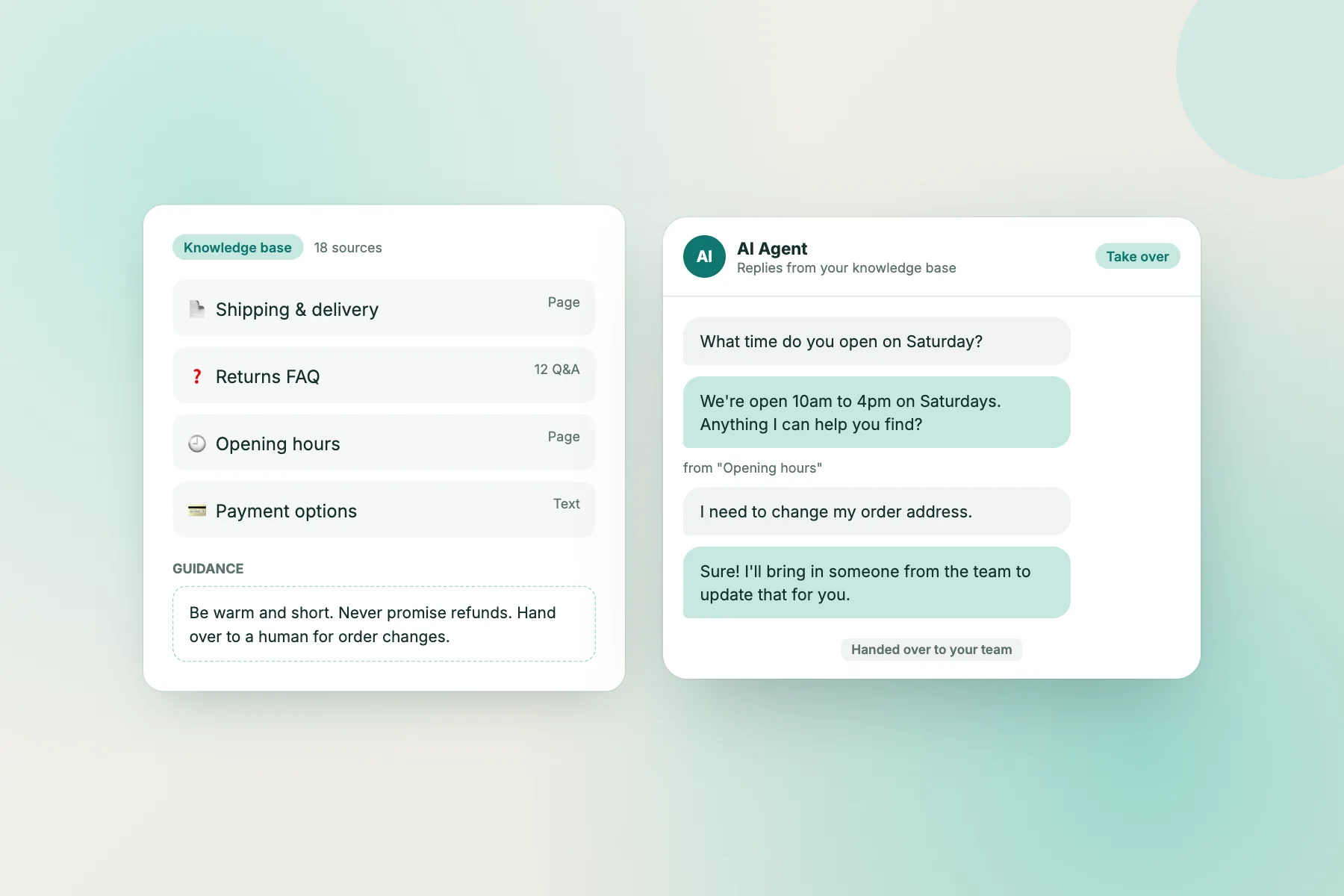
The AI Agent answers from the knowledge you give it. If you write in your knowledge notes that delivery time depends on the pin code, the assistant has the information it needs to ask for one. Write the rule plainly: “Delivery time depends on location. Ask for the pin code if the customer hasn’t shared it.” See how to train your AI chatbot.
Spreading questions for chatbot conversations across these places means each one appears at the right moment rather than all at once.
Never ask these
Questions that don’t belong in chat
Some information is unsafe to collect in a chat window, however convenient it seems.
Phrasing
Small wording changes that get more answers
How you ask matters as much as what you ask. A few habits make questions easier to answer.
- Offer options. “Morning or evening?” is easier than “What time suits you?” because the visitor only has to pick.
- Explain why. “What’s your pin code? I’ll check delivery time” gets more replies than “What’s your pin code?” on its own.
- One question per message. Two questions in one message usually get one answer, and you won’t know which one was skipped.
- Use the visitor’s words. If they said “flat,” don’t reply about “apartments.” Mirror their language.
- Keep it short. A question longer than one line on a phone screen looks like homework.
- Make “I don’t know” acceptable. “No idea about the size? That’s fine, a photo helps too.” Visitors abandon chats when they feel tested.
Read your last twenty chats with these habits in mind. You’ll probably find at least one question that could be rewritten to get a quicker, clearer answer. The live chat scripts library has more wording to borrow.
Check your setup
A quick audit of your bot’s questions
Tick each item once it’s true for the questions for chatbot replies on your website.
Reviewing
Find out which questions work
Questions are easy to test because you can see the answers. Once a month, read a sample of chats and ask three things about each question your bot or team asks.
Did people answer it?
If a question is often ignored, it’s probably confusing, too personal too early, or asked in the middle of a long message. Move it, shorten it or drop it.
Did the answer change what happened next?
A qualifying question is only useful if the reply changes the recommendation. If every answer leads to the same next message, stop asking.
Did the chat end soon after?
A question followed by silence is a warning sign. Look at what you asked just before visitors left. Requests for phone numbers too early are the most common culprit.
Write down what you change and check again next month. Good questions for chatbot conversations are rarely right first time; they get better through small, regular edits based on what real visitors did.
Getting started
Put your first question in place today
Start with the welcome message. Rewrite it to end with one easy question that splits your visitors into two or three groups: “For yourself or your child?”, “Home or office?”, “Buying or just browsing prices?” Then add one Flow on your busiest page with a question that fits that page.
You can do both on the free plan at livechatbot.in: two websites, 100 visitors per website each month, Flows with conditions and follow-ups, saved replies, opening hours with an away form, and the AI Agent with a small monthly allowance backed by the free keyword bot. Visitor packs start at ₹99 and never expire if you outgrow the free visitors.
A bot that asks one good question at the right moment will usually do more for you than one that knows a hundred answers but never asks anything at all.
Frequently asked questions
What questions for chatbot conversations should I write first?
A welcome question that splits visitors into groups, a clarifying reply for your most common vague message, and a closing question for the end of every answer.
How many questions should a bot ask before answering?
Usually one, rarely more than two. Give something useful back before asking anything else.
When should the bot ask for a phone number or email?
After it has helped, or when a person needs to follow up, and always with a reason. After hours, the away form collects them.
Can the AI Agent ask questions on its own?
Yes, if its knowledge tells it what information an answer depends on, such as a pin code for delivery times.
What should a bot never ask?
Passwords, OTPs, card numbers, CVVs or government ID numbers. Direct payments to your secure checkout instead.
Keep reading
Related guides
Personalized Chatbot Without the Creepiness: 9 Levers and Where to Stop
More to read
More guides on this topic
WooCommerce Customer Support Chatbot: Five Order Questions a Bot Should Never Guess, and the Safer Reply for Each (Free Risky-vs-Safe Examples)
Give your bot a better first question
Rewrite your welcome message tonight. Start free on livechatbot.in if you’re new.