SEO Funnel for Small Businesses: From a Google Search to a WhatsApp Message, Step by Step
SEO funnel is the path a stranger takes from a Google search to becoming your customer: they find a page, read, compare, and finally reach out by chat, WhatsApp, a call or a form. This guide shows how to plan pages for each stage, and how to measure every step on your own website so you know exactly where people drop off.

⚡ In short
- Plan content in three stages: awareness (learn), consideration (compare) and decision (buy or book).
- Measure five steps you can actually see: published, crawled, found on Google, contacted, lead.
- Find the step with the biggest drop and fix that first; it is usually not traffic.
- Make reaching out easy on every page: chat, WhatsApp, call and a short form.
The stages
The three content stages of a funnel
Marketers often draw the funnel as a wide top that narrows to a small bottom. For a small business it helps to keep it to three stages.
Awareness: “I have a question”
People search to learn: “how to remove a stain from silk”, “what does a CA charge for GST filing”. They do not know you yet. Pages here are guides and answers. Their job is to be useful and to point to your offer.
Consideration: “Which option is right?”
People compare: “kanjivaram vs banarasi”, “best coaching for JEE in Hyderabad”. Pages here are comparisons, buying guides and case examples. Their job is to build trust.
Decision: “I want to buy or book”
People are ready: “red bridal saree price”, “book AC service today”. Pages here are product, service and pricing pages. Their job is to make contacting you effortless.
Each stage needs different pages, and the types of keywords in seo guide explains how to match keywords to them.
The problem
Why most funnels are drawn but never measured
Most advice stops at drawing the funnel. The hard part is knowing, for your own pages, how many people move from one step to the next. Without that, you guess: write more blog posts, buy more ads, redesign the home page.
Google Analytics shows sessions and bounce rates, but most small businesses never connect visits to the WhatsApp messages and phone calls that actually bring money. The result is a funnel with a known top and an unknown bottom.
An example (illustrative)
A home cleaning service in Bengaluru publishes twelve pages: six service pages, four guides and two area pages. Google reads eleven of them, and nine get visitors from search. But only two pages get chats or WhatsApp clicks, and both are area pages (“deep cleaning in Whitefield”). The six service pages get visitors from search and almost no messages.
The leak is clear: found → contacted, on service pages. The fix is not more blog posts. It is adding the price range, the areas covered and a WhatsApp button to the top of each service page, and a chat greeting that asks “Which area are you in?”. A month later, service pages start bringing enquiries too.
Measuring it
Five steps you can measure on your own site
The seo cycle report in LiveChatBot turns the funnel into five measurable steps for every page:
- Published: the page exists.
- Crawled by Google: Googlebot read it, or a Google visitor proves it.
- Found on Google: at least one visitor arrived from a Google search.
- Got actions: a chat, WhatsApp click, call click or form.
- Brought leads: someone left a name, email or phone.
Each step shows how many pages reached it, so you can see where the funnel narrows.
Leaks
Find the leak, then fix only that
Compare the step boxes. The biggest drop between two neighbours is your leak, and each leak has a different fix.
Published → crawled is low
Google has not read your new pages. Link to them from pages that already get visitors, check your sitemap, and give it time. See how long does it take google to index a new page.
Crawled → found is low
Google read the pages but nobody arrives from search. The pages may target keywords that are too broad, or answer them weakly. Narrow the keyword and answer it in the first lines.
Found → contacted is low
Visitors arrive and leave. This is the most common leak for small businesses. Put the price, answer or offer in the first screen, add a chat greeting and a visible WhatsApp button. Landing page optimization shows the pages losing most visitors and why.
Contacted → lead is low
People reach out but do not leave details. Reply faster, and make sure your away form and chat rescuer ask for an email and phone number. See offline live chat.
Contact
The bottom of the funnel is a conversation
For small businesses the last step is rarely an online checkout. It is a message: “Is this available?”, “What is the price for 20?”, “Can you come on Saturday?”. The funnel only works if those conversations are easy to start and quickly answered.
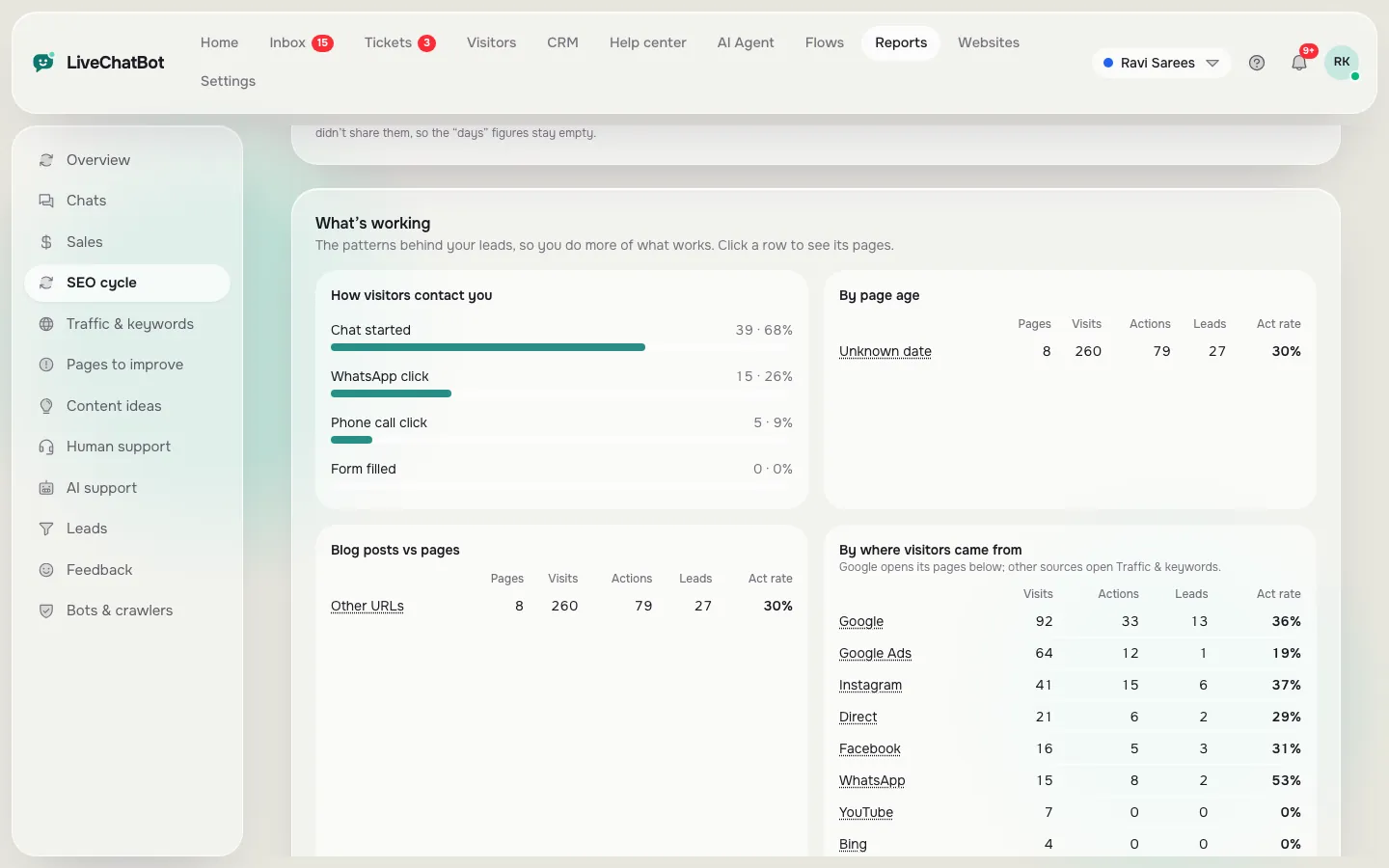
The What’s working section shows how your visitors prefer to contact you, chat, WhatsApp, phone or forms, and which traffic sources produce the most actions. Put your effort where your customers already are.
Mistakes
Five common mistakes, and what to do instead
Writing only awareness posts
Blog guides are easy to write and bring readers, but readers need somewhere to go next. If you have twenty guides and three thin product pages, fix the product pages first.
Judging pages by traffic alone
A page with many visitors and no enquiries is not your best page. Judge pages by actions and leads, and treat high-traffic, no-action pages as pages to improve.
Hiding the contact options
A phone number in the footer and a contact form on a separate page is not enough. Put chat and WhatsApp where the decision is made: on product, service and pricing pages.
Slow replies
The funnel ends with a message, and a message answered after three hours often goes to a competitor. Use alerts on your phone, an AI Agent for common questions and a chat rescuer for busy moments.
Never looking back
Pages change position, competitors publish, seasons turn. A monthly look at the five steps catches problems while they are small.
Content plan
A content plan that fills every stage
Once you know the leak, plan pages for the stage that is thin.
- Decision pages first. Make sure every product or service has a clear page with price or a price range, availability and contact options.
- One comparison per main product. Answer the “which one?” question honestly, linking to both decision pages.
- Guides from real questions. Use the questions visitors ask in chat and search on your site; they are your best awareness topics. See blog ideas from customer questions.
- Link upwards. Every guide links to a comparison or a decision page, so readers have a next step.
- Write around what earns. When a page brings leads, add supporting posts around its topic; see topic clusters for small business.
Ideas
Let your visitors fill the top of the funnel
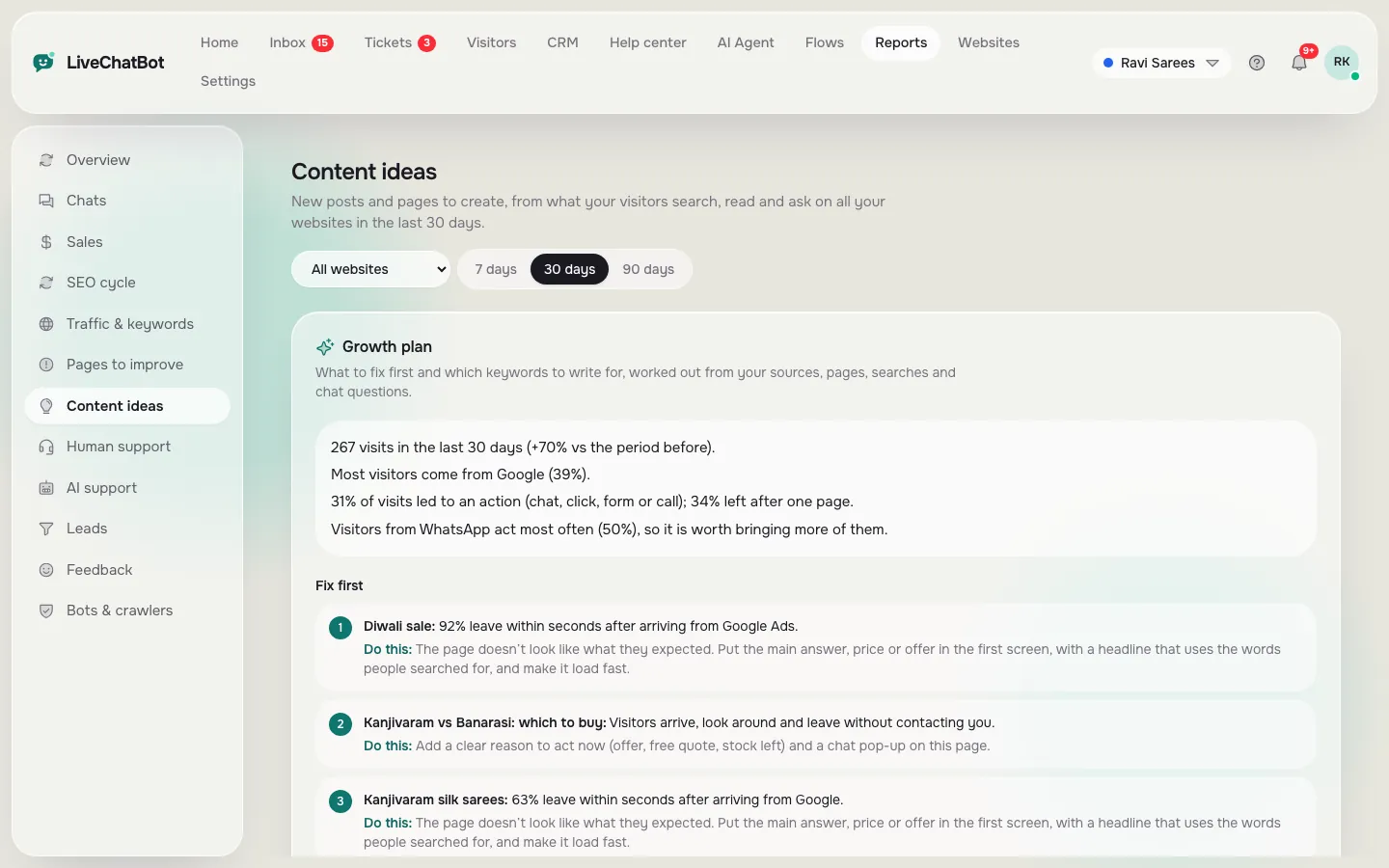
LiveChatBot’s Content ideas report builds a growth plan from your own visitors: which pages to fix first, which keywords are worth targeting, and ideas for new pages taken from site searches, rising topics and chat questions. Each idea says why it was suggested. With AutoSchedulePost connected, ideas can be written and posted to your WordPress site.
Checklist
A monthly funnel check
1
Look at the five steps
Open the SEO cycle for 90 days and note the biggest drop.
2
Fix one leak
Work only on that step this month.
3
Improve three pages
Use Pages to improve for the top three pages losing visitors.
4
Answer one missing question
Write one page for a question visitors asked that no page answers.
5
Support one money page
Add a supporting post linking to a page that brings leads.
6
Check reply speed
Make sure every chat and WhatsApp message gets a fast reply.
Get started
Measure your SEO funnel this month
Create a free account at livechatbot.in and add the chat to your website. It starts counting visits, sources, chats, WhatsApp clicks, forms and leads from the first day. After a few weeks, open Reports → SEO cycle and find your biggest leak. Read how to track leads from seo for a detailed walkthrough of the numbers.
Frequently asked questions
What is an SEO funnel?
The path from a Google search to a customer: finding a page, reading, comparing and finally reaching out or buying.
What are the stages of an SEO funnel?
Awareness (learning), consideration (comparing) and decision (buying or booking).
How do I measure my SEO funnel?
Track five steps per page: published, crawled, found on Google, contacted and lead. LiveChatBot’s SEO cycle report does this from your own site’s data.
Where do most small business funnels leak?
Usually between visit and contact: visitors arrive but find no clear answer or easy way to reach out.
Do I need Google Search Console?
Not for these steps. They come from visits, sources and actions on your own site.
Keep reading
Related guides
SEO Lead Tracking: See Which Pages Bring Leads, Not Just Visitors
SEO Cycle: Follow Every Page From Published to Crawled, Found, Contacted and Lead
How to Track Leads From SEO: A Five-Step Method for Small Business Websites
See where your SEO funnel leaks
Five measurable steps from published page to lead, for every page. Start free on livechatbot.in.