Chatterbot Meaning: Where the Word Came From, How It Differs From ‘Chatbot’, and Which Term to Use
Chatterbot meaning is simple at heart: a computer program designed to chatter, or hold a conversation, with people. But the word has a specific origin, it has been overtaken by a shorter cousin, and today it also names a popular Python library. This guide untangles all three and helps you pick the right word for your own website.
⚡ In short
- A chatterbot is a program that holds a text conversation with people. It means essentially the same as ‘chatbot’.
- The word was used by Michael Mauldin in 1994; ‘chatbot’ later became the common short form.
- ‘ChatterBot’ with a capital B is also the name of an open-source Python library for building simple bots.
- On your website, say ‘chatbot’, ‘assistant’ or simply ‘chat’. ‘Chatterbot’ sounds dated to most customers.
The meaning
What a chatterbot is
A chatterbot is a computer program built to carry on a conversation with a person in natural language, usually through typed text. The name joins “chatter”, meaning casual talk, with “bot”, short for robot. The emphasis on chatter is a clue to the word’s roots: early chatterbots were mostly designed to keep a conversation going convincingly, not to complete a business task.
In modern usage the chatterbot meaning overlaps almost entirely with “chatbot”. Dictionaries and encyclopedias generally treat the two as the same thing, with chatterbot as the older form. If you read a research paper from the 1990s or early 2000s, you’ll see “chatterbot”; in anything written in the last fifteen years, you’ll mostly see “chatbot”.
A slightly different flavour
If there’s a difference in tone, it’s this: “chatterbot” hints at small talk and personality, the kind of program that might chat with you about the weather. “Chatbot” has become the neutral, practical word, used for everything from customer service assistants to AI writing tools.
The origin
A word from the online text worlds of the early 1990s
The term is usually credited to Michael Mauldin, a researcher at Carnegie Mellon University. In the early 1990s he built a conversational character called Julia, which lived in TinyMUD, one of the text-based multi-user online worlds of the time. Players typed to move around, talk and build; Julia chatted with them, answered questions about the world and made small talk.
In 1994 Mauldin described this kind of program as a “chatterbot” in a paper about Julia and the Turing test. The word captured exactly what such programs did: they chattered. It spread through the research and hobbyist communities over the following years, and was used for well-known programs such as A.L.I.C.E. and Jabberwacky.
From chatterbot to chatbot
Language likes short words. As conversational programs moved into instant messengers in the early 2000s and into business websites and messaging apps in the 2010s, “chatbot” became the dominant form. Today “chatterbot” survives mainly in older texts, in discussions of the history of AI, and in the name of the Python library described below. For the full timeline, see our history of chatbots meaning.
Related words
Chatterbot, chatbot, bot and friends
How the common terms compare.
| Term | What it usually means | Where you’ll see it | Use it with customers? |
|---|---|---|---|
| Chatterbot | A program that holds a conversation; the older word for chatbot | Older research, AI history, the Python library | Rarely; sounds dated |
| Chatbot | Software that chats with people in text or voice | Everywhere: news, product pages, help centres | Yes |
| Bot | Any automated program, chatting or not | Tech discussions, social media, security | Sometimes, if context is clear |
| Virtual assistant | A bot that performs tasks for a user | Phones, smart speakers, some websites | Yes, if it does tasks |
| AI assistant / AI agent | A chatbot powered by a language model | Modern AI products | Yes, if it uses AI |
| Conversational AI | The technology behind AI chatbots and voice assistants | Vendor and industry writing | Rarely; jargon |
| Live chat | Real-time chat with people, not a bot | Website support | Yes, for human chat |
Related reading: chatbot vs live chat explains the difference between automated and human chat on a website.
How they work
Inside a chatterbot: then and now
Part of the chatterbot meaning is technical: these are programs that take in a message and produce a reply. How they do that has changed completely over thirty years, and the difference explains why old and new bots feel so different to talk to.
The classic approach: patterns and templates
A 1990s-style chatterbot kept a long list of patterns, each linked to one or more reply templates. When you typed a message, it looked for the pattern that best matched your words. If you wrote “I like dogs”, a pattern such as “I like *” might trigger the reply “What do you like about dogs?”, reusing part of your sentence. Some programs added memory for a few facts you’d mentioned, such as your name, and random variation so they didn’t repeat themselves. Writing a good classic chatterbot meant writing thousands of patterns by hand.
The learning approach: matching to examples
Libraries such as ChatterBot store example conversations rather than hand-written patterns. When a new message arrives, the program finds the most similar stored statement and returns the reply that followed it. It’s easier to build than thousands of rules, but it can only reuse replies it has already seen, so its answers are only as good, and as varied, as the examples it was given.
The modern approach: language models
Today’s AI chatbots use large language models that generate a new reply word by word, based on patterns learned from vast amounts of text. They don’t look up a stored reply; they write one. That’s why they handle unexpected wording so well, and also why they need to be grounded in your business facts, so the fluent reply is also a correct one.
Famous examples
Well-known chatterbots worth knowing
ELIZA (1966)
Joseph Weizenbaum’s therapist-style program at MIT. The classic early example, decades before the word chatterbot existed.
Julia (early 1990s)
Michael Mauldin’s character in the TinyMUD text world, and the program behind the word itself.
A.L.I.C.E. (1995)
Richard Wallace’s pattern-based bot, built on thousands of hand-written rules and a multiple Loebner Prize winner.
Jabberwacky
Rollo Carpenter’s bot that learned from its conversations with people, aiming for entertaining, human-like chat.
SmarterChild (2001)
A bot on AIM and MSN messengers that chatted with millions of users and answered simple questions.
Modern AI assistants
Today’s language-model chatbots, which most people now picture when they hear the word.
The Python library
When someone says ‘ChatterBot’ they might mean code
If you search for the chatterbot meaning as a developer, you may be looking for something else entirely: ChatterBot, an open-source Python library. It lets programmers build a simple conversational bot that learns responses from example conversations. You give it pairs of statements and replies, it stores them, and when a user says something, it picks the closest stored response.
What it’s good for
ChatterBot has been popular in programming courses and student projects because it shows the basic idea of a learning chatbot in a few lines of code. It’s a good way to understand how matching-based bots work: input comes in, the library finds the most similar known statement, and returns the associated reply.
What it isn’t
It isn’t a modern large language model, and it isn’t a ready-made customer service tool. It doesn’t come with a chat widget, an inbox for your team, handover to people, opening hours or visitor tracking. Businesses that want a working website assistant usually use a hosted chat platform rather than building one from a library.
If you’re a student
For a project, ChatterBot or similar libraries are a fine way to learn. If you later want to see how a production website chat works, you can sign up for a free LiveChatBot account and compare: the widget, the AI Agent, Flows and the team inbox show what a business deployment needs beyond the conversation itself.
Which word?
Pick the right term for your website
Answer three quick questions.
Naming your bot
Words customers respond to in a chat window
Whatever technical word you prefer, customers mostly see the label in your chat window: the header, the welcome line and the bot’s name. A few practical tips:
Name the help, not the technology
“Ask us about delivery, sizes or your order” tells visitors what they’ll get. “Chat with our AI chatterbot” tells them how it works, which most don’t care about.
Be honest that it’s a bot
A friendly name such as “Shop assistant” or “Mia, our assistant” is fine. Pretending to be a human isn’t. Visitors feel misled when they discover it, usually at the worst moment. A short line such as “I’m the shop’s assistant bot; I can answer most questions or get you a person” sets expectations well.
Keep the human visible
Customers are more willing to try a bot when they know a person is available. Mention it in the welcome line or offer a “Talk to a person” button. The guide on writing a welcome message has plenty of examples, and chatbot names has naming ideas for every kind of business.
In practice
What a chatterbot looks like on a business website today
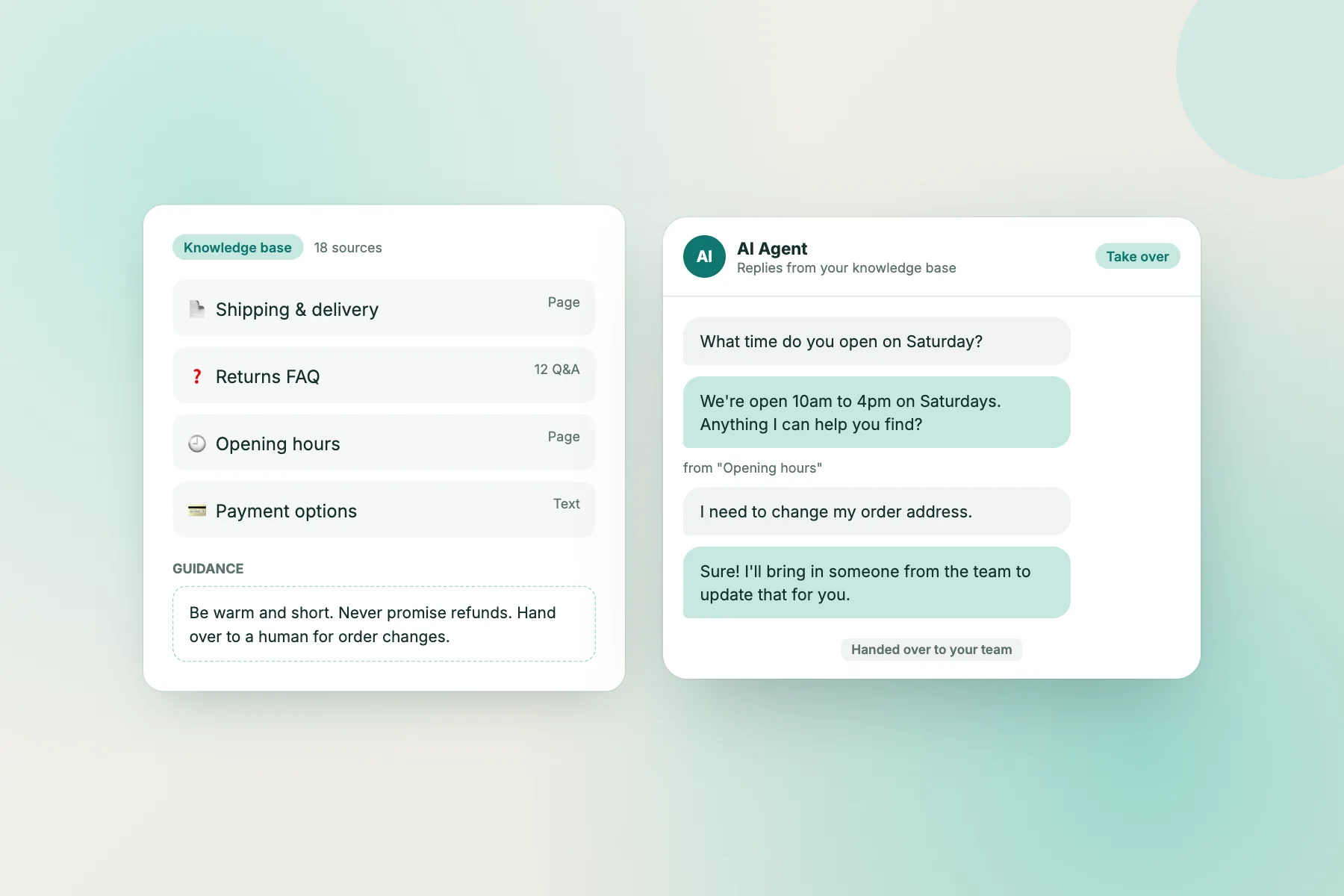
Strip away the history and the vocabulary, and a business chatterbot today does a few practical jobs: it answers common questions instantly, collects contact details when your team is away, starts helpful conversations on important pages, and passes anything complex to a person.
On LiveChatBot those jobs are handled by the chat widget, the AI Agent (with a free keyword bot as fallback), Flows for proactive messages, and an inbox and Android app for your team. The free plan covers two websites with 100 visitors per website each month; AI-written replies come with a small free monthly allowance per website. See the pricing page for details, or start free on livechatbot.in. Whatever you call it, chatterbot, chatbot or assistant, what your customers will judge is whether it helped.
Frequently asked questions
What is the chatterbot meaning in simple words?
A chatterbot is a computer program that chats with people in ordinary language. It’s the older name for what we now usually call a chatbot.
Who invented the word chatterbot?
Michael Mauldin used the term in 1994 to describe conversational programs like his character Julia in the TinyMUD online world.
Is a chatterbot different from a chatbot?
Not really. They mean the same thing; ‘chatbot’ is the shorter, modern form. ‘Chatterbot’ can hint at small talk and personality.
What is ChatterBot in Python?
ChatterBot is an open-source Python library for building simple bots that learn responses from example conversations. It’s popular for learning and student projects.
Should I call my website bot a chatterbot?
Probably not. Customers understand ‘chatbot’, ‘assistant’ or simply ‘chat’ better. Focus the label on what the bot helps with.
Keep reading
Related guides
Chatbots Meaning Through History: How the Word and the Idea Changed From 1966 to Today
Chatbot UX Design for Error Moments: How to Write the Replies for When Things Go Wrong
Chatbot UX Metrics: 8 Numbers That Tell You Whether Your Bot Is Helping or Annoying People
Whatever you call it, make it helpful
Add a chatbot that answers from your facts and hands over to your team. Free on livechatbot.in.