Chatbots Meaning Through History: How the Word and the Idea Changed From 1966 to Today
Chatbots meaning has shifted a lot over sixty years: the same word has described a 1960s psychology experiment, a 1990s game character, a messaging-app novelty and today’s AI assistants. Following that history is the clearest way to understand what a chatbot is now, and what it means for a business that puts one on its website.
⚡ In short
- Today a chatbot is software that holds a conversation in text (or voice) with a person.
- Early chatbots matched patterns in what you typed; modern ones use language models trained on huge amounts of text.
- For a business, the word now mostly means a website or messaging assistant that answers customers.
- The technology changed a lot; the core idea, talking to a computer in ordinary language, didn’t.
The plain meaning
What the word means today, in one paragraph
A chatbot is a computer program that you can talk to in ordinary language, usually by typing into a chat window, and that replies in ordinary language. The word combines “chat” and “bot”, short for robot. Some chatbots follow fixed scripts and menus; others use artificial intelligence to understand free-form questions and write their own replies. On business websites, a chatbot usually answers customer questions, collects contact details and hands harder conversations to people.
That is today’s chatbots meaning. But the idea is older than the word, and older than the internet. Looking at how it developed explains why chatbots behave the way they do, why people trust some and distrust others, and why the AI chatbots of today feel so different from the clunky ones of ten years ago. Our separate guide on what a chatbot is covers today’s types in detail; this page tells the story behind them.
Timeline
Sixty years of talking to computers
Key moments that shaped what the word means today.
Alan Turing’s paper ‘Computing Machinery and Intelligence’ proposes the ‘imitation game’: could a machine hold a text conversation well enough to pass for a person? The question frames chatbot research for decades.
Joseph Weizenbaum at MIT builds ELIZA, a program that imitates a therapist by turning a user’s statements into questions. It understands nothing, yet some users confide in it, which surprised and worried its creator.
Psychiatrist Kenneth Colby builds PARRY, which simulates a person with paranoid thinking. It shows that a program with a consistent ‘personality’ can seem convincing in short exchanges.
Michael Mauldin uses the term ‘chatterbot’ for conversational programs, in work on a character called Julia that chatted with players in online text worlds. ‘Chatbot’ later becomes the common short form.
Richard Wallace’s A.L.I.C.E. uses a large set of hand-written pattern rules. It goes on to win the Loebner Prize, a contest for human-like conversation, several times.
SmarterChild chats with millions of users on instant messengers such as AIM and MSN, answering questions and making small talk. Many people’s first chatbot conversation happens here.
Apple launches Siri on the iPhone 4S. Talking to software becomes an everyday habit, and expectations rise: people now expect a bot to do things, not just chat.
Messaging platforms open up to business bots. Thousands of companies launch menu-driven bots; many disappoint because they understand little beyond buttons and keywords.
Google researchers publish ‘Attention Is All You Need’, describing the transformer architecture. It becomes the foundation of modern large language models.
OpenAI releases ChatGPT in November 2022. Millions of people experience a chatbot that writes fluent, flexible answers, and the word ‘chatbot’ takes on a new, much more capable meaning.
Businesses combine AI chatbots with their own knowledge, so a website bot can answer questions about their products and policies, and hand over to people when needed.
Three eras
How the meaning changed as the technology changed
Looking across the timeline, the history of chatbots meaning falls into three broad eras. Each one left habits and expectations that still shape how people react to a chatbot today.
Era 1: pattern matching (1960s–2000s)
ELIZA, PARRY and A.L.I.C.E. worked by spotting patterns in what the user typed and responding with prepared templates. If you wrote “I am sad”, ELIZA might reply “Why are you sad?” by reusing your own words. These bots could feel surprisingly alive in short chats, but they understood nothing. Step outside their patterns and they produced nonsense. In this era, a chatbot was mostly a research project, a game or a curiosity.
Era 2: menus and keywords (2010s)
When businesses started deploying bots at scale, most were built from decision trees: buttons, menus and keyword triggers. “Press 1 for orders” moved into chat windows. These bots were predictable and easy to control, which businesses liked, but they frustrated customers whenever a question didn’t fit the menu. Much of the public’s scepticism about chatbots comes from this era.
Era 3: language models (2020s)
Large language models changed what a chatbot could do. Instead of matching patterns, they generate replies based on statistical patterns learned from enormous amounts of text, which lets them handle questions phrased in countless ways, including typos and mixed languages. The challenge shifted from “can it understand?” to “can it stay accurate?”, which is why business chatbots today are given their company’s own knowledge and rules.
Then and now
The same visitor question, answered by each era
Reflects your words back; no real help.
Your question isn’t on the menu.
Understands, answers from the shop’s policy, offers next steps.
Why it matters
What this history means for a business today
Knowing where chatbots came from helps you avoid repeating old mistakes and set the right expectations with customers.
Customers arrive with memories
Many visitors have been stuck in a menu-era bot that didn’t understand them. They open your chat expecting the same. A specific welcome line, a quick accurate first answer and a visible way to reach a person all help overcome that history in the first few seconds.
Fluent isn’t the same as correct
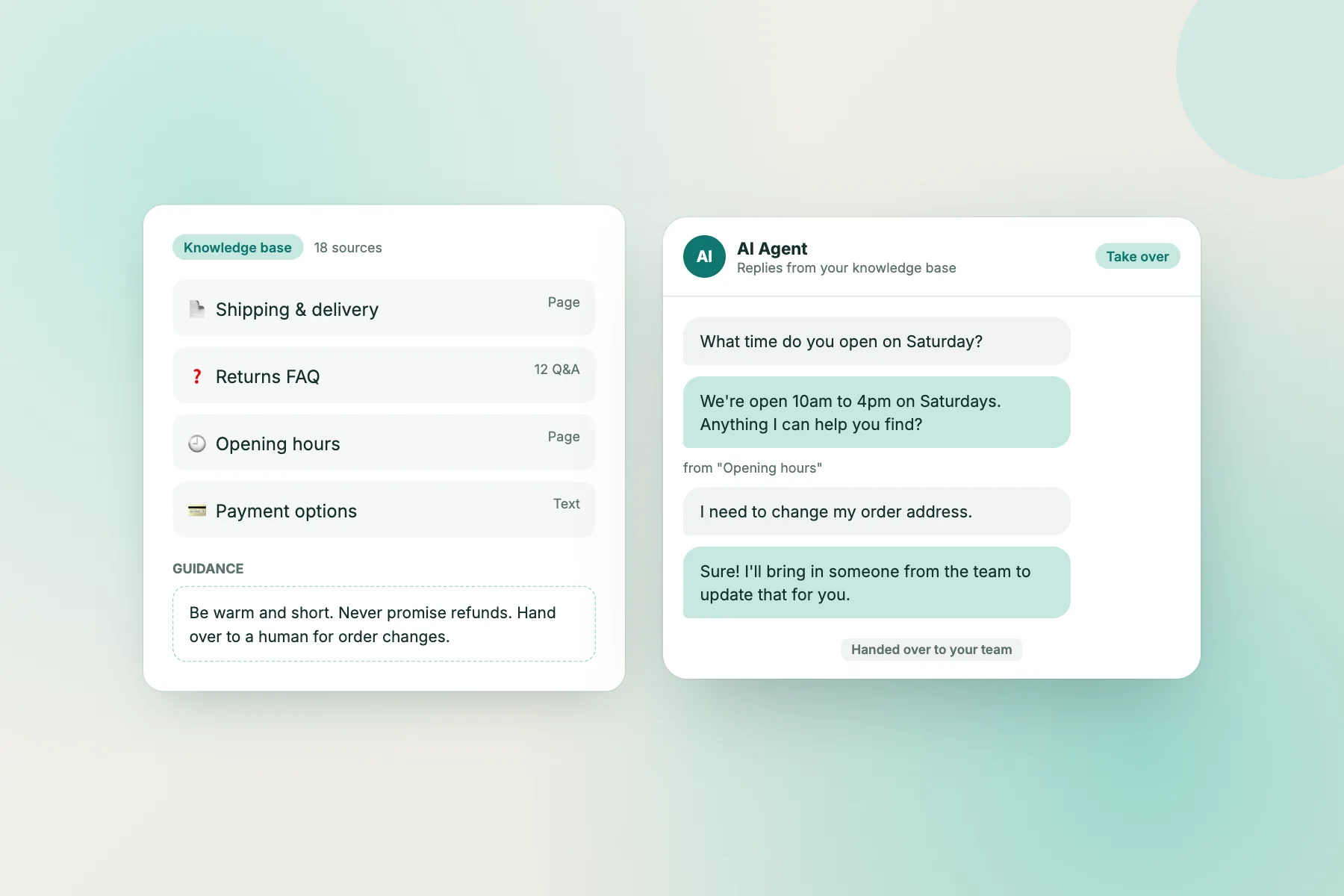
Language-model chatbots write fluent answers even when they’re wrong. That’s why business chatbots should answer from your own facts, not general knowledge, and why you should read conversations regularly. The AI Agent on LiveChatBot answers from the knowledge you give it, with a free keyword bot as a fallback when AI replies aren’t in use.
The menu era still has lessons
Buttons and keywords weren’t all bad. They’re predictable and fast for common paths. Modern website chat often combines both: quick-reply buttons for the most common questions, and free text with AI for everything else. Chat Flows are a modern version of that structured approach.
Weizenbaum’s warning
ELIZA’s creator was disturbed that people confided in a program that understood nothing. His concern still applies: a chatbot shouldn’t pretend to be a person or give advice it isn’t qualified to give. Be clear that customers are talking to a bot, and hand sensitive topics to people.
Common myths
Four things people still believe about chatbots
Each era left behind beliefs that no longer match reality. Clearing them up helps you explain your own website bot to customers and colleagues.
“Chatbots only understand exact keywords”
True of many menu-era bots, not of modern ones. Today’s AI chatbots handle typos, slang and mixed languages such as Hindi and English in one sentence. Keyword bots still exist and are useful for predictable questions, but they’re no longer the only option.
“Chatbots are meant to replace people”
For most businesses, the opposite is true. A website bot takes the repeat questions, such as delivery times, opening hours and return rules, so people have time for the conversations that need judgement and care. Good bots hand over quickly.
“AI chatbots know everything”
They know a lot of general language, but nothing about your shop’s return window unless you tell them. That’s why business bots are given company knowledge, and why their answers should be checked.
“Chatbots are expensive and technical”
They used to be. Today a small business can add a website chatbot by pasting one line of code or installing a plugin, often for free to start.
Words
Chatbot vocabulary, then and now
Search for any term you’ve come across.
Today’s meaning on a website
What ‘chatbot’ means when a customer sees one on your site
When a visitor sees a chat bubble on a business website today, they expect a few things, shaped by this whole history: an instant reply, an answer about *this* business rather than generic information, and a way to reach a person if the bot can’t help. They don’t expect the bot to pretend to be human, and they react badly when it does.
Meeting those expectations doesn’t require a large budget. LiveChatBot’s free plan includes the chat widget, Flows, the keyword bot, visitor tracking, tickets and an Android app for two websites, with 100 visitors per website each month. AI-written replies come with a small free monthly allowance per website and can be topped up. Read more on the pricing page, compare approaches in chatbot vs live chat, or start on livechatbot.in and see what today’s version of a sixty-year-old idea looks like on your own site.
Frequently asked questions
What is the simple chatbots meaning?
A chatbot is a computer program that talks with people in ordinary language, usually in a chat window, and replies with text. ‘Chatbots’ is simply the plural.
What was the first chatbot?
ELIZA, created by Joseph Weizenbaum at MIT in the mid-1960s, is usually described as the first well-known chatbot.
Who coined the word chatterbot?
Michael Mauldin used the term ‘chatterbot’ in 1994 for conversational programs. ‘Chatbot’ later became the common short form.
Are modern chatbots really intelligent?
They are very good at producing fluent language, but they can still be confidently wrong. That’s why business chatbots should answer from verified company knowledge and hand over when unsure.
Has the chatbots meaning changed over time?
Yes. It has moved from research experiments to menu-driven business bots to today’s AI assistants that answer from company knowledge.
Is a chatbot the same as live chat?
No. Live chat connects visitors with people; a chatbot replies automatically. Many websites use both in the same chat window.
Keep reading
Related guides
Chatbot UX Design for Error Moments: How to Write the Replies for When Things Go Wrong
Chatbot UX Metrics: 8 Numbers That Tell You Whether Your Bot Is Helping or Annoying People
Chatbot User Interface on Phones: Designing for Thumbs, Keyboards and Slow Networks
See today’s chatbot on your own website
Add a chatbot that answers from your business facts and hands over to your team. Free on livechatbot.in.