AI Bot Meaning, Explained With 6 Everyday Analogies (and Where Each One Breaks Down)
AI bot meaning is easier to grasp through comparisons than definitions. An AI bot is a program that understands messages written in ordinary language and replies automatically, but that sentence only really clicks when you compare it to things you already know. Here are six everyday analogies, what each gets right, and, just as importantly, where each one breaks down.
⚡ In short
- An AI bot is software that understands ordinary language and replies automatically.
- It’s like a well-briefed receptionist in some ways, and like your phone’s autocomplete in others.
- Each analogy breaks somewhere; those breaking points explain what AI bots can’t do.
- For a business, the key is giving the bot your facts and a clear way to hand over to people.
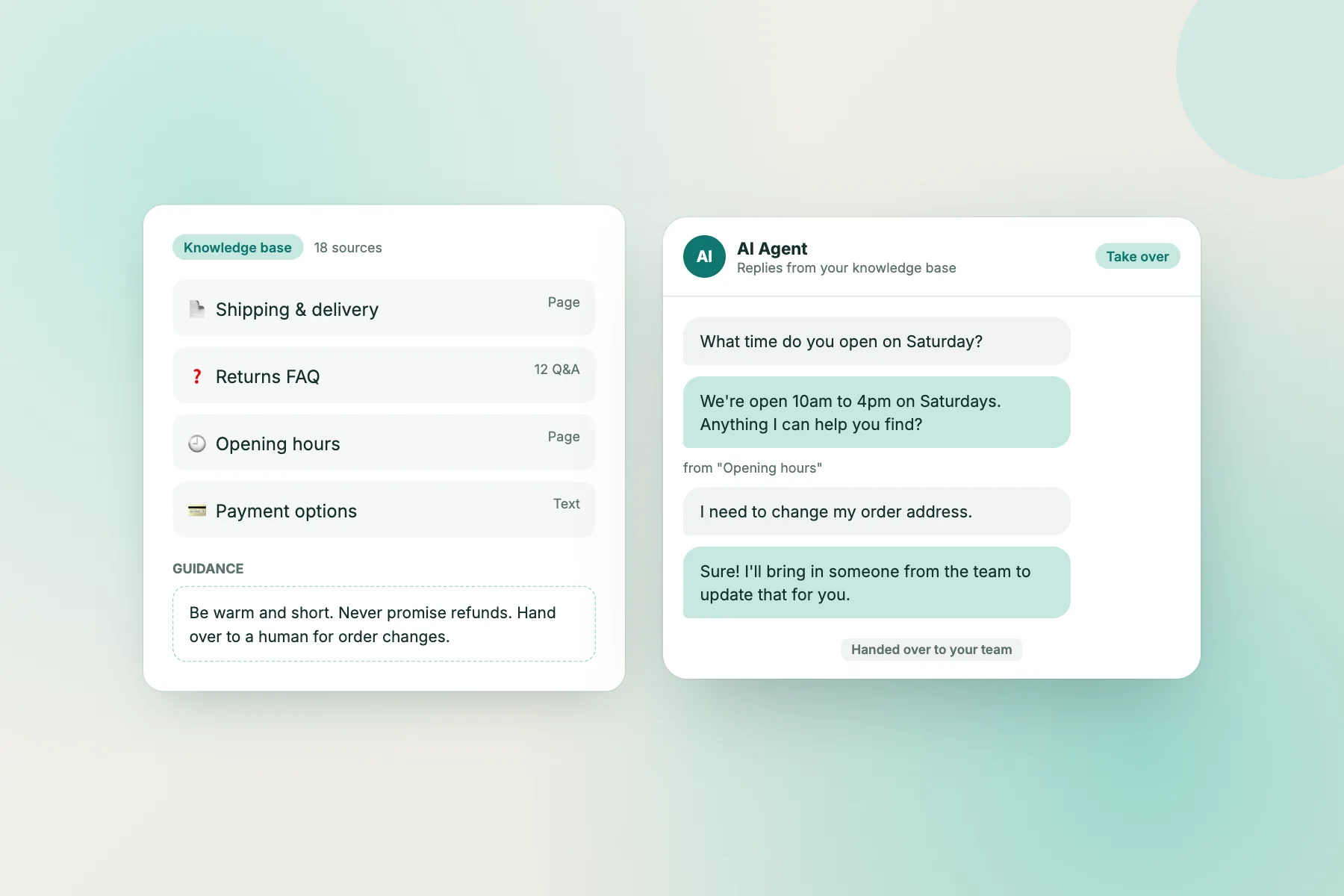
The one-sentence version
Start with the plain definition
An AI bot is a computer program that reads what a person types (or says) in ordinary language, works out what they mean, and responds automatically, usually in writing. “AI” means it uses artificial intelligence, typically a language model trained on large amounts of text, rather than a fixed list of rules. “Bot” is short for robot, in the sense of an automated program.
That’s accurate, but it doesn’t tell you what it feels like to use one, what it’s good at, or where it goes wrong. Analogies help with all three. None of them is perfect; that’s the point. Each comparison captures part of the AI bot meaning, and each place it fails teaches you something about the technology’s limits. Understanding both sides is what helps business owners use these bots well and customers trust them appropriately.
Six analogies
What an AI bot is like, and what it isn’t
Read the ‘where it differs’ lines carefully. They matter more than the similarities.
1. A well-briefed receptionist
How it’s similar: It greets visitors, answers common questions, and directs people to the right person when it can’t help.
Where it differs: A receptionist knows when something feels wrong and uses judgement. An AI bot only knows what it was given and may answer confidently even when it shouldn’t.
Takeaway: Brief it well, and give it clear rules about when to call a person.
2. Your phone’s autocomplete, grown up
How it’s similar: Modern AI language models work by predicting likely next words, a bit like a vastly more capable version of the suggestions above your phone keyboard.
Where it differs: Autocomplete suggests a word; an AI bot writes whole, fluent answers. But both predict what sounds right, which isn’t the same as checking what is true.
Takeaway: Fluency is not proof of accuracy. Answers need to come from verified facts.
3. A librarian who reads very fast
How it’s similar: Given your documents, it can find the relevant part and summarise it in response to a question.
Where it differs: A librarian knows which sources are outdated. An AI bot treats whatever it’s given as true, so an old price list produces old prices.
Takeaway: Keep the material it reads current and consistent.
4. A new intern on day one
How it’s similar: Eager, quick, good with words, and able to handle routine questions once shown how.
Where it differs: An intern learns from mistakes over time on their own. A business bot improves when you update its knowledge and instructions.
Takeaway: Review its work regularly and correct the source of mistakes.
5. A vending machine, versus a barista
How it’s similar: Older, rule-based bots were like vending machines: press a button, get a fixed item. AI bots are more like a barista who understands ‘something cold, not too sweet’.
Where it differs: A barista can tell you when they’re out of milk. An AI bot needs to be told what’s available, or it may offer what doesn’t exist.
Takeaway: Tell it clearly what you do and don’t offer.
6. A sat-nav for questions
How it’s similar: It takes where you are (your question) and guides you to where you want to go (an answer, a page, a person).
Where it differs: A sat-nav follows real maps; if the map is wrong, so is the route. Same with a bot’s knowledge.
Takeaway: The quality of the map, your content, decides the quality of the route.
What the breaking points teach
Three lessons hidden in the analogies
Look at where each analogy breaks down, and three themes repeat. Together they’re the most useful part of understanding the AI bot meaning for a business.
Lesson 1: it doesn’t know what it hasn’t been told
The receptionist, librarian, vending machine and sat-nav analogies all fail at the same point: the bot only knows what it was given. It can’t sense that a policy changed last week or that you’re out of stock. For a business, this means the bot’s knowledge must be current and complete for the questions customers actually ask. Our knowledge audit guide explains how.
Lesson 2: sounding right isn’t being right
The autocomplete analogy shows why AI bots can be fluent and wrong at the same time. They produce language that sounds plausible. When they’re grounded in your facts, plausible and true line up. When they aren’t, they drift apart.
Lesson 3: judgement stays with people
The receptionist and intern analogies both break on judgement: knowing when something is unusual, sensitive or high-stakes. AI bots should hand those moments to people. That’s not a weakness to hide; it’s how a good service is designed.
In action
The analogies in a real-style conversation
Each line below shows one of the analogies at work.
Understands typos, answers from the salon’s prices, hands a health question to a person.
Line by line
– Understanding “hey do u do keratin and how much”: the grown-up autocomplete at work, making sense of informal, abbreviated text. – “Starts at ₹3,500… about 2 hours”: the librarian, reading the salon’s own price list rather than guessing. – “Want me to check this Saturday?”: the receptionist, moving toward a booking. – “That’s one to check with your doctor”: the boundary where judgement belongs to people. – “Have our senior stylist call you”: the sat-nav, routing to the right destination.
Related words
Bot, chatbot, AI bot, assistant: how they relate
You’ll see several overlapping words, and they’re often used loosely. Here’s how they usually relate.
- Bot: any automated program. Not all bots chat; some index websites, post on social media or run tasks.
- Chatbot: a bot that holds conversations. It may be rule-based or AI-powered.
- AI bot / AI chatbot: a chatbot that uses AI, typically a language model, to understand and reply.
- AI assistant or AI agent: often used for AI bots that can also take actions, such as creating a ticket or booking a slot, not just answer.
- Live chat: conversation with real people, often in the same window as a bot.
For more on the wider family of bots, see our guide to AI bots for business, and for the word’s history, our page on chatbots meaning.
For business owners
What the AI bot meaning implies for your website
If you’re considering an AI bot for your website, the analogies translate into a short to-do list.
- Brief it like a receptionist. Give it your hours, prices, delivery rules, returns and booking process, written clearly.
- Keep its library current. Update the knowledge whenever something changes, and remove anything outdated.
- Check its work like an intern’s. Read a sample of conversations weekly and correct the source of any mistakes.
- Tell it what’s off the menu. List what you don’t offer and what it must never answer (medical, legal, financial advice, disputes).
- Give it a person to call. Set up handovers, opening hours and alerts so humans pick up what the bot shouldn’t handle.
On LiveChatBot, the AI Agent answers from the knowledge you provide, with a free keyword bot that uses your saved replies when AI replies aren’t in use. The free plan covers two websites, and AI replies come with a small monthly allowance; see the pricing page.
For customers
What this means when you’re the one chatting
If you’re on the other side, chatting with a business’s AI bot, the same analogies suggest some sensible habits.
- Expect it to know the business, not everything. It’s a briefed receptionist, not an oracle.
- Double-check important numbers. For prices, dates or policies that matter a lot to you, ask for the source or confirm with a person.
- Ask for a person when it matters. Complaints, unusual requests and anything sensitive deserve a human; a good bot will hand over.
- Never share passwords, OTPs or card details in chat, whatever the bot asks.
- Be clear and specific. The bot handles informal language well, but a clear question gets a clearer answer.
- Give feedback. If an answer was wrong or unhelpful, say so in the chat or tell the business. Most owners read their conversations and fix the source, so your feedback improves the bot for the next person.
- Expect honesty about being a bot. A good business makes it clear when you’re talking to software. If you’re unsure, simply ask; a well-designed bot will tell you.
Check yourself
Which statements are true?
Tick the ones you agree with, then read the notes.
Frequently asked questions
What is the simple AI bot meaning?
An AI bot is software that understands messages in ordinary language and replies automatically, using artificial intelligence rather than fixed rules.
Do I need technical knowledge to use an AI bot on my website?
No. Adding one is usually a copy-paste or plugin install, and you teach it by writing your business facts in plain language.
Is an AI bot the same as a robot?
No physical robot is involved. ‘Bot’ means an automated program; everything happens in software.
Can an AI bot think?
Not in the human sense. It predicts and generates language based on patterns, and answers from the information it’s given. It doesn’t have judgement or understanding the way people do.
Why do AI bots sometimes get things wrong?
Because they produce plausible-sounding text. Without accurate, current information to answer from, plausible can be wrong.
How do businesses use AI bots?
Mostly to answer common customer questions instantly, collect contact details out of hours, and pass complex or sensitive conversations to people.
Keep reading
Related guides
AI Bot Free Trial Plan: How to Test a Free Bot for 14 Days and Know Whether to Keep It
AI Based Chatbot Knowledge Audit: Which of Your Pages and Documents to Feed It, and How to Fix Them First
Advanced Chatbot Setup: 9 Power-User Techniques Most Small Businesses Never Switch On
See the analogies in action on your own site
Brief an AI bot with your facts and test it free on livechatbot.in.