Bot Technologies Compared on One Question: Keyword Rules, Fuzzy Matching, Search and AI Answers (Free Matching Simulator)
Bot technologies are usually explained one at a time, which makes them all sound clever. This guide does something more useful: it takes one real visitor question, with a typo in it, and shows what each method does with it. You’ll see where exact keyword rules break, how fuzzy matching rescues some questions, how search ranks your answers, and why an AI reply depends on all of that. A free simulator lets you try your own answers and questions.
Illustrative: same question, two methods.
⚡ In short
- Most website bots combine four methods: exact keyword rules, fuzzy matching, search over your answers, and an AI model that writes the reply.
- Each method fails in a predictable way. Knowing how helps you write answers that every method can find.
- AI replies don’t replace good answers. They depend on search finding the right text first.
- Test your own questions in the simulator below before you trust any setup.
Why compare
The same question, four different journeys
When you shop for a website bot, every product page says it understands your customers. That sentence hides very different machinery. Some bots look for exact words. Some forgive spelling mistakes. Some search your help pages. Some hand everything to a large language model. Most real products mix several of these.
You don’t need to know the maths. You do need to know how each method behaves, because it changes how you should write your answers, which questions will slip through, and what to test before going live.
The easiest way to see the differences is to follow one question through each method. We’ll use this one, typed by an illustrative visitor to an illustrative clothing shop:
“how many days for shiping to chennai”
It’s a perfectly normal question. It has a typo (“shiping”), it doesn’t use the word “delivery”, and it includes a city name the bot has never seen. Real visitors write like this all the time, often on a phone, often in a hurry, sometimes in a second language.
Our shop’s bot has five short answers: delivery times, returns, opening hours, cash on delivery and sizing. Each answer has a few keywords attached. That’s a typical small-business setup, and it’s exactly what you’ll load in the simulator further down.
Let’s see what happens.
Four methods
What each one does with a question
Looks for a listed word in the message. “delivery” or “shipping” → delivery answer. Fast, predictable, unforgiving.
Treats near-misses as matches: word endings (shipped → ship) and one-letter typos (shiping → shipping).
Scores every answer by how much it overlaps with the question and ranks them. Uses the answer text too, not just keywords.
A language model reads the best passages from search and writes a reply in natural words.
Method 1
Exact keyword rules: fast, clear and easily fooled
The oldest of the bot technologies is also the simplest. You write a list of words for each answer. If the visitor’s message contains one of those words, the bot sends that answer. If it contains none, the bot sends a fallback like “Sorry, I didn’t understand”.
Our question contains “shiping”, not “shipping”, and no other delivery keyword. So the rule doesn’t fire. The visitor gets the fallback.
That sounds bad, and for typos it is. But keyword rules have real strengths:
- They’re predictable. You know exactly which words trigger which answer, so there are no surprises.
- They never invent anything. The bot only ever sends text you wrote.
- They’re cheap and instant. No model to pay for, no waiting.
The weaknesses are just as clear. Typos, different words for the same thing (“courier”, “parcel”, “dispatch”), and other languages all slip past unless you add them by hand. And a keyword can fire in the wrong place: “I don’t want a refund, I want an exchange” contains “refund”.
How to write for it: list several words for every answer, including common misspellings and local terms. For delivery, that might be delivery, deliver, shipping, ship, courier, parcel, dispatch, and “kab milega” if your customers write in Hinglish.
LiveChatBot’s free keyword bot works this way: it answers from your saved replies when the AI Agent is unavailable or its allowance is used up. Our keyword rule guide shows how to test your rules.
Method 2
Fuzzy matching: forgiving typos and word endings
Fuzzy matching keeps the keyword idea but loosens the rule. Instead of demanding the exact word, it accepts words that are close.
Two kinds of closeness matter most:
Word endings
“Shipped”, “shipping” and “ships” all share a root. A simple step called stemming cuts endings off so they all compare as “ship”. That alone catches a lot of real questions.
Typos
“Shiping” is one letter away from “shipping”. Fuzzy matching counts how many single-letter changes turn one word into another (called edit distance) and accepts small differences in longer words. Most systems are stricter with short words, because “ship” and “shop” are also one letter apart and mean different things.
Run our question through fuzzy matching and it now finds the delivery answer. The visitor is helped.
What fuzzy matching still can’t do is understand meaning. “How long until my parcel arrives” shares no close words with “delivery, shipping, deliver”, so it still fails unless “parcel” or “arrive” is added. And loosening too far creates false matches, which are worse than a fallback because the visitor gets a confident wrong answer.
How to write for it: you no longer need every misspelling, but you still need different words for the same idea. Test with short words, where fuzzy matching is weakest.
Free tool
Run your own question through each method
Add your bot’s answers as keywords | answer lines, type a question the way a real visitor would, and see what each method does with it.
Your bot’s answers, one per line: keywords | answer (keywords separated by commas).
A visitor’s question (try typos and other words for the same thing)
Runs only in your browser; nothing is sent or saved. A simplified teaching model, not a copy of any product’s engine.
Method 3
Search: ranking every answer, not just matching one
Search works differently. Instead of asking “does this message contain a trigger word?”, it asks “which of my answers is most similar to this message?” and scores all of them.
In our example, the question’s useful words are “days”, “shiping” and “chennai”. Search looks for those words, or close versions of them, in the keywords and in the answer text itself. The delivery answer contains “days” and, through fuzzy matching, “shipping”. It scores highest. Returns, which mentions “7 days”, scores a little. The others score nothing.
That ranking is the big advance. It means:
- Answer text counts. A well-written answer that mentions the words customers use gets found even without a long keyword list.
- Close calls are visible. When two answers score almost the same, you know the bot might mix them up, and you can make them more distinct.
- It scales. Search works over a whole help centre or product catalogue, not just a handful of rules.
Modern systems often go a step further and compare meanings rather than words, using what are called embeddings, so “parcel” can match “delivery” with no shared letters at all. The simulator uses word overlap to keep it understandable, but the lesson is the same: what search can find depends on what your answers say.
How to write for it: write answers in your customers’ words, not your internal terms. Put the key fact in the first sentence. Keep each answer to one topic so it scores cleanly. Our knowledge audit guide walks through which pages and documents to feed a bot.
Method 4
AI answers: fluent, but only as good as what they read
The newest of the bot technologies is the one people mean when they say “AI chatbot”. A large language model takes the visitor’s message plus the best passages that search found, and writes a reply in natural language.
For our question, a well-set-up AI would read the delivery passage and reply something like: “We deliver to Chennai in 3 to 6 working days, and orders over ₹999 ship free.” It handled the typo, used the city name naturally and picked the useful detail. That’s why AI replies feel so much better than keyword rules.
But notice the order of events. The AI didn’t know your delivery times. Search found them, and the AI rephrased them. If search had found nothing, or the wrong passage, a careful AI should say it isn’t sure and offer a person. A careless setup may write something plausible and wrong.
That’s the most important thing to understand about AI bots for a small business: the quality of the answer depends on the quality of your written knowledge and the search that finds it. The model makes good knowledge sound natural; it can’t fix missing or outdated knowledge.
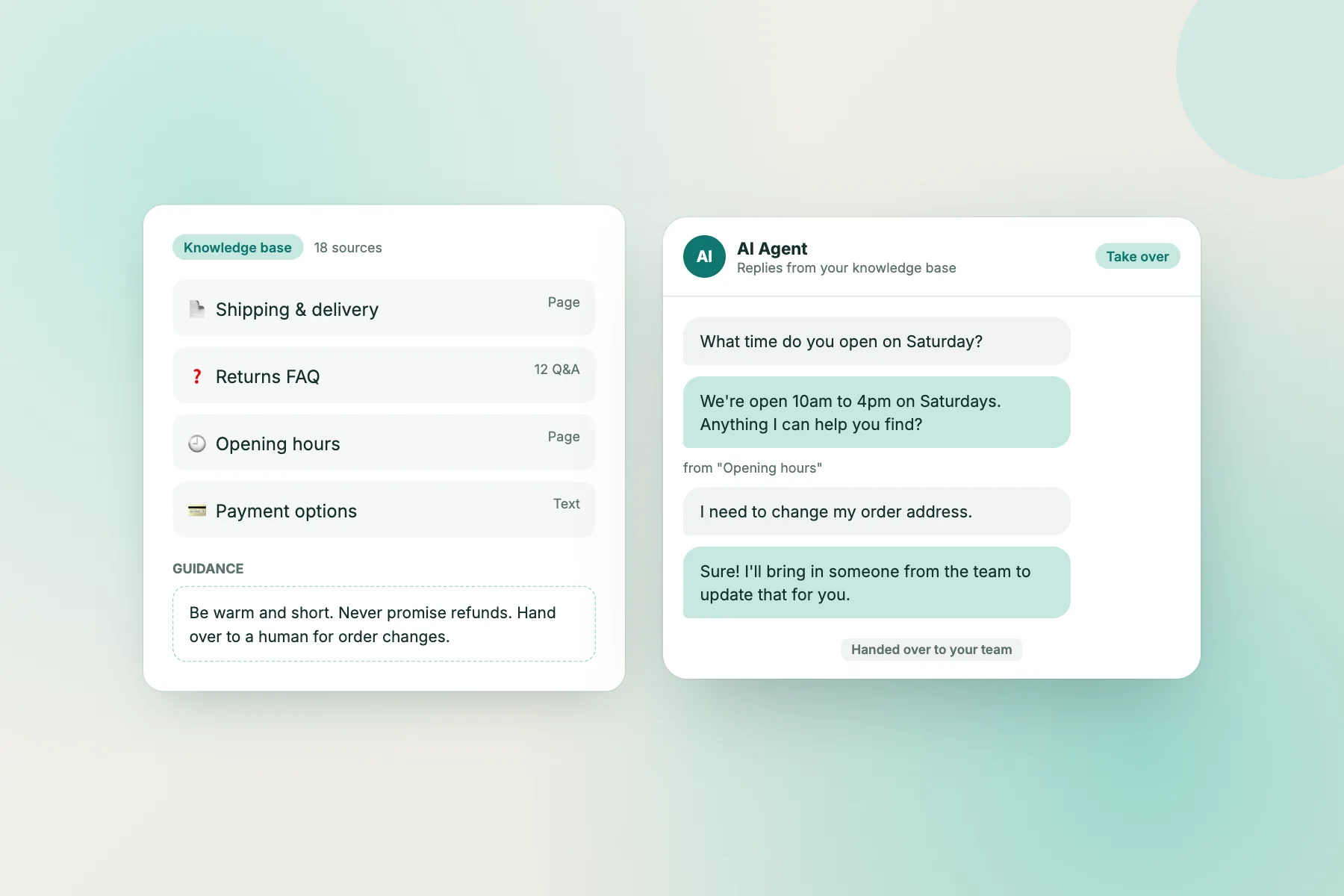
In LiveChatBot, the AI Agent answers from the knowledge you give it and hands over to your team when it can’t help. Our AI training guide covers how to write that knowledge, and our AI Agent page explains how it falls back to the keyword bot.
Side by side
How the methods compare
| Keyword rules | Fuzzy matching | Search | AI answer | |
|---|---|---|---|---|
| Handles typos | No | Small ones | With fuzzy step | Yes |
| Handles other words for the same thing | Only if listed | Only if listed | If the answer uses them | Usually |
| Can say something you didn’t write | Never | Never | Never | Yes, if badly set up |
| What you maintain | Keyword lists | Keyword lists | Answer text | Answer text + instructions |
| Typical failure | Fallback reply | Wrong close match | Wrong passage ranked first | Fluent reply from the wrong passage |
Choosing
Which mix suits a small business
You rarely choose just one method. Most practical setups layer them, and the right mix depends on how many questions you get and how much they vary.
A handful of repeat questions, low budget. Keyword rules with generous word lists can cover most of it. Add misspellings and local terms. Accept that unusual phrasing will reach a person, and make sure a person is reachable.
Dozens of question types, varied wording. Search over well-written answers, with an AI writing the reply, earns its keep here. Your main job becomes keeping the answers accurate and in customers’ words.
Questions that must never be wrong (prices, medical, legal, account-specific). Keep these with people, or answer them from short, exact text and test them often. Our number check guide shows how to test every price and date your bot quotes.
Whatever the mix, keep a fallback. When the AI is unavailable or unsure, a keyword answer or a clear handover is far better than a guess. That layered approach is how good bot technologies feel reliable: not because any single method is perfect, but because each one covers another’s gaps.
If you’re unsure which level you need at all, our capability ladder helps you find it.
Before you trust it
A ten-question test for any bot
Getting started
Write answers every method can find
Whatever bot technologies sit behind your chat, the same habits help all of them. Write short answers in your customers’ words, one topic each, with the key fact first. Attach several keywords, including local terms. Then test with typos, synonyms and questions you can’t answer, using the simulator above and the ten-question list.
LiveChatBot’s free plan includes an AI Agent with a small free monthly allowance, a free keyword bot that answers from saved replies, the team inbox, the Android app, Flows and tickets, for two websites with 100 visitors per website each month. See pricing and start at livechatbot.in.
Frequently asked questions
What are the main bot technologies used in website chat?
Most website bots combine exact keyword rules, fuzzy matching for typos and word endings, search that ranks your written answers, and an AI model that writes a natural reply from what search finds.
Why does my bot miss questions with typos?
Exact keyword rules only fire on the exact word. Fuzzy matching or an AI layer handles small typos; otherwise add common misspellings to your keyword lists.
Does an AI chatbot still need written answers?
Yes. The AI writes the reply, but it relies on your written knowledge for the facts. Missing or outdated text leads to missing or wrong replies.
Can an AI bot give a wrong answer?
It can, especially if search ranks the wrong passage first or nothing relevant exists. A good setup tells the bot to say it is unsure and offer a person instead of guessing.
Which method is best for a small business?
A layered mix: AI answers from good written knowledge, with keyword replies as a fallback and a clear way to reach a person. Keep account-specific and money questions with your team.
Keep reading
Related guides
Bot Live Chat Weekly Review: Read Last Week’s Chats and Decide What the Bot Learns Next (Free Outcome Tagger)
Bot in Chat With Your Team: Who Speaks When, So the Bot and Staff Never Talk Over Each Other
Bot Companies and Lock-In: Score How Hard It Would Be to Leave Before You Sign
Answers every method can find
Give the AI Agent good written knowledge and keep a keyword fallback. Start free on livechatbot.in.