Advantages of a Chatbot, Measured: Work Out the Hours and After-Hours Enquiries It Saves for Your Business Type
Advantages of a chatbot are usually sold as a list: available 24/7, faster replies, lower costs, more leads. The list is true in general and useless for a decision, because the same advantage is worth a lot to one business and almost nothing to another. A shop that gets half its chats at night gains something very different from a clinic whose patients message at 11 am. This guide turns the usual list into numbers you can calculate for your own business, explains where each number comes from, and is honest about when the gain is too small to bother.
⚡ In short
- Only a handful of chatbot benefits can be measured: time back, after-hours cover, instant answers to buyers, consistency and captured contact details.
- Which one matters most depends on your chat volume, how repetitive the questions are and when people write to you.
- Use the calculator with your own numbers. The presets are illustrative starting points, not statistics.
- Under about five chats a day, saved replies and an away form may give you most of the benefit for less effort.
Why lists don’t help
The same advantage is worth different amounts to different businesses
Every article about bots repeats the same benefits. They are all real. But a list doesn’t tell you whether a bot is worth an afternoon of your time, because it ignores three facts about your business.
How many chats you get. A bot that answers 60% of questions saves real hours for a shop with thirty enquiries a day. For a consultant with three a week, it saves minutes.
How repetitive they are. A salon gets the same five questions all day: price, timing, location, availability, parking. A software company gets long, specific questions about a customer’s own account. Bots are excellent at the first kind and weak at the second.
When people write. If most of your enquiries come between 10 am and 6 pm while someone is at the desk, “available 24/7” is a small advantage. If 40% arrive after dinner, it’s the biggest one.
So instead of asking “what are the benefits?”, ask “how big is each benefit for me?” That is a question you can answer with seven numbers you probably already have, or can collect in a week. The rest of this guide shows how, and the one-page business case guide shows how to present the result to a partner or manager.
Free tool
Calculate your chatbot advantages
Pick a business type for illustrative starting numbers, then replace them with your own. The tool shows which advantage is biggest for you.
Runs in your browser; nothing is saved or sent. Presets are illustrative guesses, not industry statistics. Results are estimates from the numbers you enter.
Collecting the numbers
Where to find each of the seven inputs
To measure the advantages of a chatbot you don’t need perfect data. A week of rough counting is enough to see which advantage dominates.
Chats or enquiries per day
Count every written or spoken question from a potential or existing customer: website chat, WhatsApp, phone calls, Instagram messages, emails. If you only have website chat today, multiply by the share of people who would use chat if it answered instantly. Most owners start by counting one normal week and dividing by seven.
Share of repeat questions
Go through one day of messages and mark each one: is this a question someone else asked this week? Price, delivery, timings, location and “is this available” are almost always repeats. “Can you check my order 4471?” is not. Our auto chat bot audit has a quick sorting method.
Share the bot can fully answer
Some repeat questions have a simple, fixed answer (“We’re open 10 to 8, Monday to Saturday”). Others need a person even though they repeat (“My parcel is late”). A careful first guess is half to two-thirds of repeat questions.
Minutes per chat
Time a few replies, including finding the information and typing. Two to six minutes is common for simple questions; longer if staff switch between tasks.
Share outside working hours
Look at message timestamps for a week. Count everything that arrives when nobody would reply within ten minutes, including lunch breaks and Sundays.
Staff cost per hour
Monthly salary divided by working hours, or what your own hour is worth if you answer chats yourself.
Share of buying or booking enquiries
Mark messages where someone is ready to buy, book or ask for a quote. These carry the most value when answered fast.
Typical patterns
Which advantage usually wins, by business type
Illustrative patterns from the presets above. Your own numbers decide.
| Business | Questions are mostly… | Busy times | Usual biggest advantage |
|---|---|---|---|
| Online shop | Delivery, COD, returns, sizes | Evenings, weekends | Time back and night cover |
| Clinic | Timings, fees, doctors, booking | Mornings | Consistency and booking speed |
| Coaching centre | Fees, batches, demo class | Evenings, results season | After-hours cover for parents |
| Real estate | Price, location, site visit | Weekends, late evenings | Fast answers to buyers |
| Salon | Price list, availability | Mid-day, festival weeks | Time back at the front desk |
| Software / SaaS | Account-specific, how-to | Office hours across time zones | Night cover, with careful handover |
Advantage 1
Time back: what saved hours really mean
The calculator multiplies repeat questions by the share the bot can answer and by minutes per chat. If your result is 15 hours a month, that’s roughly two working days your team doesn’t spend typing “Yes, we deliver to Nagpur.”
Be careful how you use that number. Saved hours only become saved money if you change something: you hire later, someone stops working weekends, or the time goes into work that earns, like calling back quotes. Often the honest benefit is quality rather than cost. The person at the desk is interrupted less, so the customers who do need a person get a better conversation.
Two things shrink time savings in practice. First, a badly written bot creates extra work when customers come back confused. Second, some customers ask the bot and then ask a person the same question anyway, because they don’t trust the answer. Both are fixable: clear answers with exact numbers, and a visible “talk to a person” option. If the advantage still looks small after a month, read the chats where people asked twice, and rewrite those answers first.
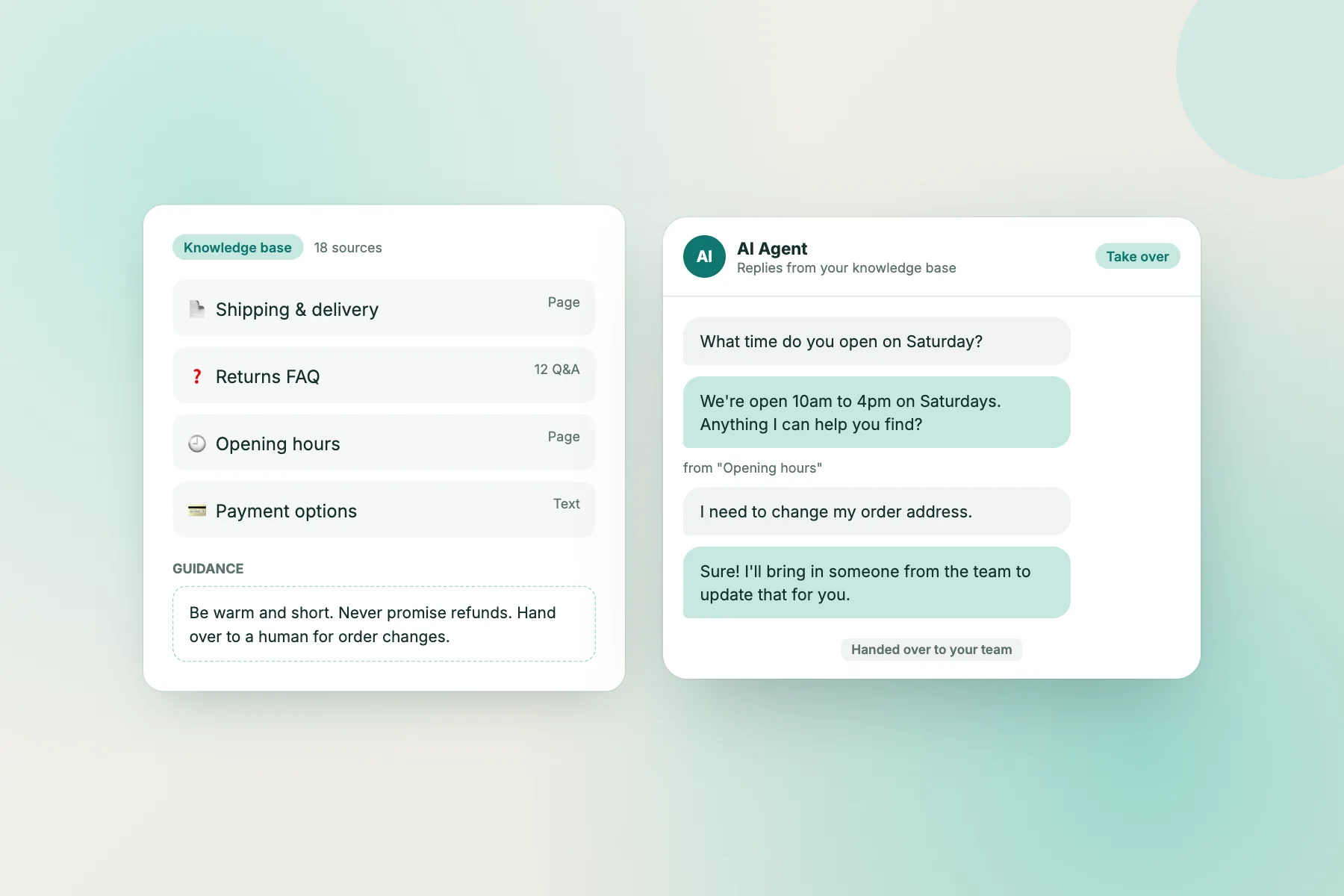
In LiveChatBot, simple answers live as saved replies. The AI Agent answers from the knowledge you give it, and when AI replies aren’t available, the free keyword bot answers from those same saved replies, so the time saving doesn’t disappear at month end.
Advantage 2
After-hours cover: answering while you’re closed
This advantage is the easiest to underestimate. A question at 10:30 pm that gets an answer at 10 am often gets no reply at all, because the customer has already bought or booked elsewhere.
The calculator shows two numbers. Night chats answered instantly are the repeat questions that arrive after hours. Buying enquiries after hours are the ones you most want to keep. For those, the bot’s job isn’t to close the sale; it’s to give the basic answer and collect a phone number or email so a person can follow up first thing in the morning.
Setting this up well takes three pieces:
- Opening hours, so the chat knows when your team is away. See how to set live chat opening hours.
- An away form that collects email or phone, with a message that promises a specific time: “We’ll call you between 10 and 11 am.”
- Answers for the night questions. Look at your after-hours messages specifically. They often differ from daytime ones: more “is this in stock?”, fewer “where is my order?”
Offline messages can become tickets, so nothing left at night is lost in a busy morning inbox.
Harder to count
Advantages that don’t show up in a calculator
Real, but don’t put a rupee figure on them in your business case.
Consistency
Every customer gets the same, correct answer, whether your most experienced person or a new hire is on shift. Price mistakes and outdated policy answers drop.
A list of real questions
Every chat is a record of what customers want to know. After a month you know which product pages are unclear and which policies confuse people.
Fewer interruptions
Staff who answer the phone, serve walk-in customers and handle chats switch tasks constantly. Each question the bot answers is one fewer switch.
Faster training
New staff can read the bot’s answers to learn your policies. The answer set becomes your shortest training manual.
Languages
Customers who write in another language can get the welcome message and replies in their language, which matters for businesses serving several states.
Calmer peak days
On sale days and results days, the bot absorbs the flood of identical questions while people handle the unusual ones.
Honest limits
When the advantages are too small to bother
A calculator that only ever says “yes” isn’t worth using. Here is when the numbers usually point the other way.
Very low volume. Under about five chats a day, the time saved is small, and the effort of writing and maintaining answers can exceed it. Live chat with saved replies and a good away message may be all you need for now.
Mostly unique questions. If most messages are about a specific order, account or case, the bot can’t answer them. It can still greet people, collect details and route them, but don’t expect big time savings.
Advice with consequences. Medical, legal and financial questions should reach a qualified person. A bot can answer timings and fees, but should hand over anything that sounds like advice.
No one to maintain it. A bot with last year’s prices does more damage than no bot. If nobody will check the answers monthly, start small.
If your numbers land here, the advantages of a chatbot are real but small for you today, and that’s a useful result too. You’ve learned that your money and time are better spent elsewhere, and you can re-run the numbers when volume grows. The 10-question worksheet helps you decide between yes, no and not yet.
Make it real
A four-week plan to capture the advantages you calculated
Measure first, so you can compare honestly afterwards.
1
Week 1 · Baseline
Count chats per day, repeat questions, after-hours messages and how long replies take. Write the numbers down.
2
Week 2 · Top ten answers
Write clear answers for the ten most common repeat questions, with exact prices, timings and policies.
3
Week 3 · Switch on
Turn on the bot, opening hours and the away form. Read every bot conversation daily for the first week.
4
Week 4 · Compare
Re-run the calculator with real numbers: how many chats did the bot fully answer, and how many night enquiries left contact details?
Measuring after launch
Check the advantages against what actually happened
After a month, replace your guesses with real numbers and run the calculator again.
- Share fully answered: chats where the visitor got their answer and didn’t ask for a person. Compare it with your week-1 guess.
- Repeat-and-ask-again rate: chats where the bot answered but the visitor asked a person the same thing. High numbers mean the answers need work.
- After-hours contacts: how many night visitors left a phone or email, and how many of those turned into sales or bookings after a morning call.
- Response time during busy hours: with the bot taking repeats, do people who need a person get one faster?
The honest comparison often shows that the real advantages of a chatbot differ from the ones you expected. Many owners expect time savings and find the bigger win is night enquiries they never knew they were losing. Others expect lead capture and find the main benefit is a calmer front desk. Whatever you find, the numbers tell you what to improve next. For a fuller set of measures, see our guide to chatbot UX metrics.
Getting started
Try it on your own numbers this week
Count one week of enquiries, run the calculator, and look at which advantage comes out on top. If it’s time back, start with your ten most repeated questions. If it’s after-hours cover, start with opening hours and the away form. If it’s speed for buyers, put prices and availability in the first answers and make the handover to a person quick.
LiveChatBot gives you the chat widget, team inbox, Android app, Chat Flows, opening hours, away form, saved replies and the AI Agent. The free plan covers two websites with 100 visitors per website each month, and there are no per-seat charges. Start on livechatbot.in.
Frequently asked questions
What are the main advantages of a chatbot for a small business?
Time back from answering repeat questions, instant answers outside working hours, faster replies to buyers, consistent answers and contact details collected from people who would otherwise leave. How much each is worth depends on your chat volume and timing.
How do I calculate the time a chatbot saves?
Multiply your monthly chats by the share that are repeat questions, the share of those the bot can fully answer, and the minutes a person spends per chat. Divide by 60 for hours.
Is a chatbot worth it with only a few chats a day?
Often not yet. Under about five chats a day, saved replies and a clear away form may give most of the benefit. Re-check when volume grows.
Does a chatbot replace staff?
Usually it takes the repeat questions so people can handle the conversations that need judgement. Saved hours become savings only if you change how the time is used.
Are the presets in the calculator real statistics?
No. They are illustrative starting points so you can see how the calculation works. Replace them with your own counts from a normal week.
Find out which advantage matters for you
Count a week of enquiries, run the numbers, and start with the biggest win. Start free on livechatbot.in.