2 Types of Chatbots, Rule-Based and AI: The Short Answer, the Long Answer and a 12-Scenario Drill to Tell Them Apart (Free Type Spotter)
2 types of chatbots come up again and again, in exam papers, interviews and sales calls: rule-based bots that follow paths and keywords someone wrote in advance, and AI-based bots that understand free-typed messages and work out a reply. This guide gives you a three-line answer you can write from memory, a full comparison, how each type actually works inside, why most real bots now mix both, and a free 12-scenario drill that tests whether you can tell them apart from how a bot behaves.
⚡ In short
- Rule-based chatbots follow buttons, decision trees or keyword rules written in advance. Predictable, cheap, limited to what was planned.
- AI-based chatbots use language models to understand free-typed messages and produce a reply. Flexible, but they can be wrong in new ways.
- One test separates them: type something the owner never wrote down. A rule bot fails or repeats its menu; an AI bot usually copes.
- Most business bots today are hybrids: AI for open questions, rules for fixed paths and as a fallback.
The short answer
The two types in three lines
If you need the answer in one breath, here it is:
Rule-based chatbots reply by following rules a person wrote: buttons, decision trees or keyword matches. AI-based chatbots use natural language processing or a large language model to understand what the user typed and work out a reply. Rule-based bots are predictable but rigid; AI bots are flexible but need checking.
That’s the split most courses, textbooks and articles use. You’ll also meet other names for the same idea:
- Scripted, decision-tree, menu-based or button bots all mean rule-based.
- Conversational, NLP, intelligent or generative bots usually mean AI-based.
- Some vendors split chatbots into task-oriented (declarative, built for one job such as booking or tracking) and data-driven (predictive, learning from data and conversations). It overlaps heavily with rule-based versus AI, but not perfectly, because a task-oriented bot can use AI to understand the request.
If a question asks for the two types without naming a framework, rule-based and AI-based is the safe answer. Mention the other names in one line to show you know them.
Why does the split matter outside exams? Because the two types fail differently. A rule bot fails loudly: “Sorry, I didn’t understand.” An AI bot can fail quietly, with a fluent answer that’s wrong. Knowing which type you’re dealing with tells you what to test, what to trust and what to watch. For the bigger picture of what a chatbot is, our plain-English chatbot guide covers the basics.
Side by side
The 2 types of chatbots compared point by point
| Rule-based | AI-based | |
|---|---|---|
| How it decides | Matches buttons, paths or keywords to stored replies | A model interprets the message and selects or writes a reply |
| Input it handles | Clicks, or typed words it was given | Almost any phrasing, typos, mixed languages |
| Replies | Fixed, word for word | Retrieved or generated; wording may vary |
| Built by | Writing rules, menus or flowcharts | Giving it knowledge and instructions, sometimes training data |
| Typical failure | “Sorry, I didn’t understand” | A confident answer that’s wrong or made up |
| Predictability | Very high | Lower; needs testing and guardrails |
| Effort to cover a new question | Add a rule or branch | Add the fact to its knowledge |
| Running cost | Very low | Pay per reply or an allowance, for model use |
| Best for | Fixed processes, short menus, exact answers | Open questions in customers’ own words |
| Example | Track order / Returns / Sizes buttons | Answers “is COD ok for Kerala?” from your policy page |
Type 1
How rule-based chatbots work inside
A rule-based chatbot is a set of if-this-then-that instructions. There are three common styles, and many bots combine them.
Buttons and menus
The bot offers choices and each click leads to the next message. Nothing is typed, so nothing can be misunderstood. This is the easiest kind to build and the hardest to break, but visitors can only go where the menu goes.
Decision trees
A bigger version of the menu, usually drawn as a flowchart: “Is this about an order? Yes → Do you have the order number? No → Here’s how to find it.” Good for processes with a clear order, like booking or troubleshooting.
Keyword rules
The visitor types freely, and the bot looks for words it knows. If the message contains “delivery”, “shipping” or “courier”, send the delivery reply. It feels more natural than buttons, but it only understands the words someone listed. “When will my stuff arrive?” fails unless “arrive” is on the list. Our rule tester guide shows how to write keyword rules that don’t misfire.
Strengths and limits
Rule-based bots never invent anything. Every reply is one you wrote, so they’re safe for prices, policies and anything legal. They’re cheap to run and behave the same every time. Their limit is coverage: they handle exactly what you planned and nothing else. As questions grow, the rules multiply, overlap and start to fight. You can see a complete one, every rule included, in our bike service centre example.
Type 2
How AI-based chatbots work inside
An AI-based chatbot uses a language model to deal with whatever the visitor types. There are two generations worth knowing about.
Intent classification (older NLP bots)
The builder lists intents, such as “delivery question” or “refund request”, and gives each one example phrases. A machine learning model learns to sort new messages into those intents, then the bot sends the stored reply for that intent. It understands more wordings than keyword rules, but the replies are still fixed, so it sits halfway between the two types.
Large language models (today’s AI bots)
A model such as those behind ChatGPT or Claude reads the message, plus the knowledge and instructions the business gave it, and writes a reply. It copes with typos, Hinglish, long rambling messages and follow-up questions. The good ones are grounded: they answer only from the business’s own information and hand over when the answer isn’t there.
Strengths and limits
AI bots cover far more questions with far less setup. You give them your FAQs and policies instead of writing a rule for every wording. The trade-offs are cost, since every reply uses the model, and a new kind of error: the made-up answer. A rule bot can only be wrong in ways you wrote; an AI bot can be wrong in ways nobody wrote. That’s why AI bots need clear knowledge, a short list of things they must never say, and regular checks. Our grounding checker shows how to catch invented answers, and the behaviour test shows how much AI is really inside a given bot.
Free tool
Spot the type: a 12-scenario drill on the 2 types of chatbots
Each scenario describes how a bot behaves. Pick rule-based, AI-based or hybrid, then check your answers. Every scenario comes with a one-line explanation.
Read each description of a real-world bot and pick its type. R = rule-based, A = AI-based, H = hybrid (both working together).
Runs only in your browser; nothing is sent or saved. The scenarios are illustrative.
The real world
Why most bots you meet are hybrids
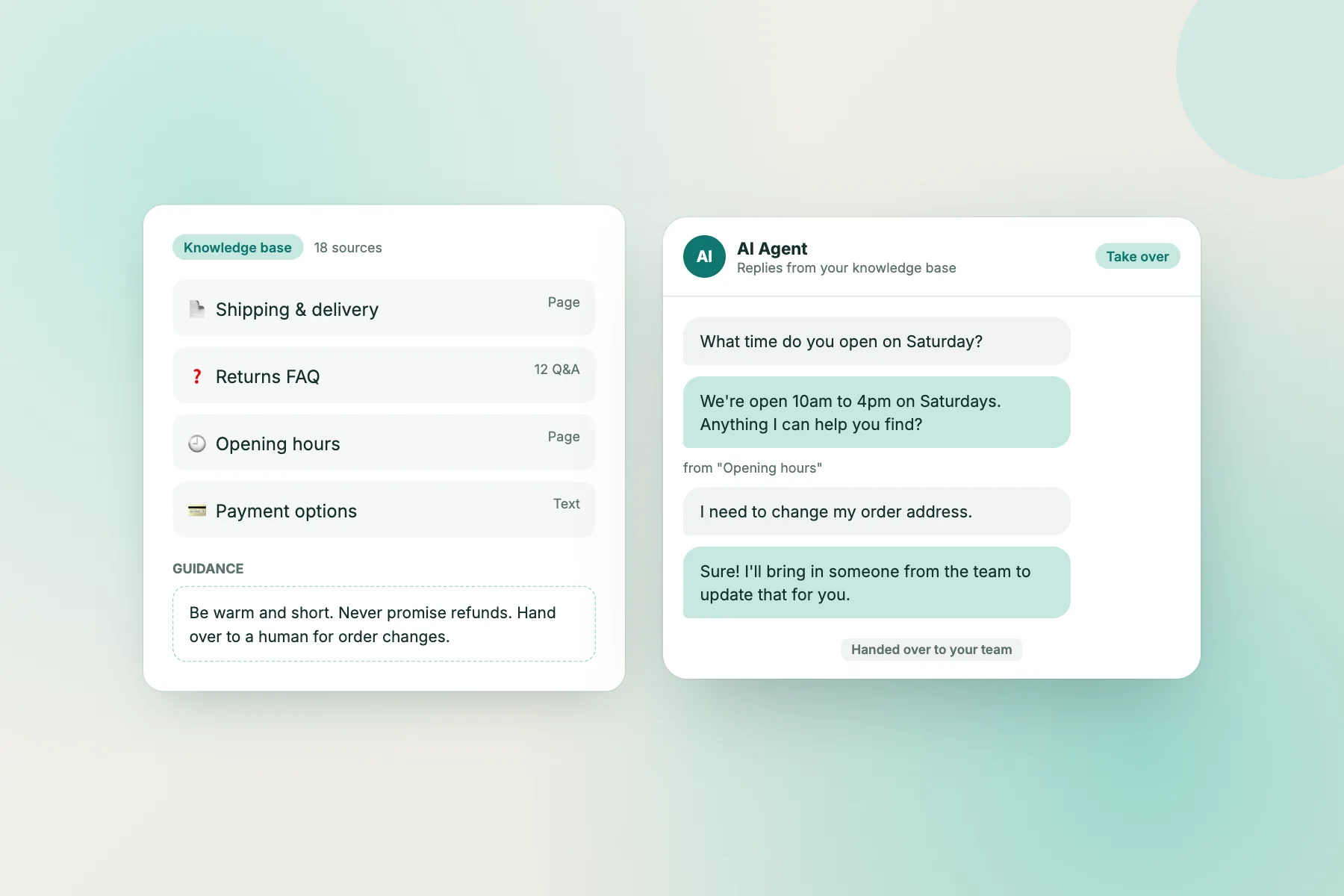
Ask which of the two types a modern business bot is, and the honest answer is often "both". Each type covers the other's weak spot, so builders combine them:
- Buttons up front, AI behind. The bot greets with three or four buttons for the most common paths, and answers anything typed with AI.
- AI first, rules as a safety net. The AI answers from the business's knowledge; if it can't, or isn't available, a rule layer answers from fixed replies or hands over.
- Rules for the risky bits. Prices, refunds and legal wording come from fixed replies, even in an AI bot, so they're always exact.
- A person at the end. Whatever the type, a good bot passes the chat to a human when it can't help.
LiveChatBot works this way. The AI Agent answers from the knowledge you give it, with a small free monthly allowance per website. When AI replies aren't available or the allowance is used up, the free keyword bot answers from your saved replies, which is the rule-based type. Anything neither can answer goes to your team in the shared inbox or the Android app.
So when you describe a real bot, don't force it into one box. Say which parts are rule-based and which are AI. That's also the most useful way to plan your own: decide, question by question, which type should answer. Our two-minute quiz helps you pick a starting point for a website.
Which one, when
Picking a type for each job
A quick guide for business owners deciding what their bot should use.
Use rules for
Fixed processes (booking steps, returns steps), exact facts that must never vary (prices, refund terms), and short menus for the top three questions.
Use AI for
Questions people phrase in many ways, product and policy questions answered from your pages, mixed-language messages and follow-ups.
Use a person for
Anything about a specific order, payment or complaint, and anything the bot gets wrong twice.
For students
Writing the answer for 2, 5 and 10 marks
If the 2 types of chatbots come up in a test, match the length to the marks.
2 marks
Name both and give one line each. "The two types are rule-based chatbots, which reply using predefined rules, menus or keywords, and AI-based chatbots, which use NLP or machine learning to understand user input and generate responses."
5 marks
Add how each works, one example each and one advantage and disadvantage each. A rule-based example: a bank bot with buttons for balance, statements and branch timings. An AI example: a shopping assistant that answers "will this fit a 40 chest?" from the size chart. Close with one line on hybrids.
10 marks
Use headings: definition, working of rule-based bots (menus, decision trees, keyword matching), working of AI bots (intent classification, large language models, grounding), a comparison table like the one above, applications, limitations (rigidity versus made-up answers), and a short conclusion on hybrid bots. A simple diagram helps: user message → rule matcher → stored reply, beside user message → language model plus knowledge → generated reply.
For project work, our guides on writing an abstract and building a presentation pick up from here.
Frequently asked questions
What are the 2 types of chatbots?
Rule-based chatbots, which follow buttons, decision trees or keyword rules written in advance, and AI-based chatbots, which use natural language processing or large language models to understand messages and form replies.
Is a keyword bot rule-based or AI?
Rule-based. It matches words someone listed to stored replies. It doesn't understand meaning, so a wording it wasn't given will miss.
Is ChatGPT a chatbot?
Yes, an AI-based one built on a large language model. Business AI bots use similar models but are limited to the business's own knowledge and instructions.
Which type is better for a small business website?
Usually a hybrid: AI for open questions in customers' own words, fixed replies for exact facts like prices, and a hand-over to a person for order-specific questions.
Does the type spotter drill save my answers?
No. It runs entirely in your browser and nothing is sent or saved.
Keep reading
Related guides
WP Chat Plugin Server Load: Will Chat Slow Down Your WordPress Hosting? Work It Out Before You Install (Free Load Estimator)
WordPress Online Chat Plugin or a Code Snippet? Four Ways to Add Chat, and a Snippet Generator for More Control
WordPress Chat Plugin Conflicts: Find the Plugin Breaking Your Chat in Five Rounds (Free Conflict Finder)
Use both types on your website
An AI Agent for open questions, a free keyword bot as the fallback, and your team for the rest. Start free on livechatbot.in.