Good Chatbots Share 9 Traits: A Self-Scoring Rubric to Grade Your Own Website Bot
Good chatbots are not the ones with the cleverest AI. They are the ones that answer the question a visitor actually asked, admit what they don’t know, and get a person involved before anyone gets annoyed. This rubric breaks that down into nine traits you can score from 0 to 3 in about twenty minutes, so you know exactly what to fix first on your own website bot.
⚡ In short
- Score your bot on nine traits, 0 to 3 points each, for a total out of 27.
- The traits fall into three groups: understanding, honesty and handover, and fit with your business.
- Fix the lowest-scoring trait first; it usually costs you more than everything else combined.
- Re-score once a month with fresh test questions, not the ones you trained on.
Why a rubric
Opinions about bots are cheap; scores are useful
Ask five people whether a chatbot is any good and you’ll get five answers based on one conversation each. One person asked an odd question and got a strange reply. Another asked about delivery and was delighted. Neither tells you much about how the bot treats the hundreds of visitors who arrive each month.
A rubric fixes that. It turns “I think the bot is okay” into a number you can compare month to month, and it points at the specific weakness to work on. It also stops the most common mistake small businesses make: endlessly tweaking the welcome message while the bot quietly gives wrong delivery dates.
The nine traits below come from watching what separates bots that customers keep using from bots they close after one reply. None of them need special technology. A simple keyword bot can score well on several; a powerful AI bot can score badly on most if nobody has taught it your facts.
How to score
For each trait, run the test described, then give 0, 1, 2 or 3 points:
- 0 — the bot fails the test or makes things worse.
- 1 — it works sometimes, or only for perfectly worded questions.
- 2 — it works reliably, with small gaps.
- 3 — it works well, and you’d be happy for a new customer to see the transcript.
Use your phone, use a private browser window so the bot treats you as a new visitor, and write your scores down. A spreadsheet with nine rows and a column per month is all you need.
Group A · Understanding
Traits 1–3: does it understand what people mean?
The basics. If these score low, nothing else matters yet.
1
Understands messy questions
Test: type five questions the way customers really do: typos, no punctuation, mixed Hindi and English, half sentences. “cod hai kya”, “delivry to pune how many days”.
3 points: all five get a relevant answer first time.
2
Answers the actual question
Test: ask “Do you deliver on Sundays?” A weak bot replies with your whole delivery policy. A strong one says yes or no, then adds one useful detail.
3 points: direct answer in the first sentence, every time.
3
Remembers the conversation
Test: ask about a product, then ask “is it available in blue?” without naming it again.
3 points: the follow-up is understood in context without repeating yourself.
Group A in practice
What low scores look like, and the usual cause
When a bot scores 0 or 1 on understanding, owners often blame the technology. Usually the cause is simpler.
Messy questions fail
A keyword bot only matches the words you gave it. If customers write “COD” and your saved reply only lists “cash on delivery”, the match fails. Add the short forms, common misspellings and local words to your saved replies. With an AI bot, this trait is normally strong, but check it anyway with your customers’ real phrasing; read the last month of chats and copy their exact words into your test list.
The answer is buried
Long answers usually come from long source text. If you pasted your full shipping policy into the bot’s knowledge, it will tend to quote large parts of it. Write short question-and-answer pairs instead, with the answer in the first sentence. Our guide to writing answers your bot can use shows the format.
Context is lost
If the bot forgets the product after one message, check whether you’re testing a button-only flow. Button flows often reset between steps. That’s acceptable for simple menus, but for product questions a bot that reads free text is the better fit.
Low scores in Group A are the most urgent to fix, because every other trait depends on the bot understanding the visitor in the first place.
Group B · Honesty and handover
Traits 4–6: does it know its limits?
This is where good chatbots and bad ones differ most.
1
Says ‘I don’t know’ honestly
Test: ask something you never taught it, like “Do you have a branch in Nagpur?”
3 points: it says it isn’t sure and offers a person or a way to find out. No invented answers.
2
Hands over without a fight
Test: type “I want to talk to a human”.
3 points: it offers a person immediately, or explains honestly when someone will reply and takes your contact details.
3
Is open about being a bot
Test: ask “Am I talking to a real person?”
3 points: a clear, friendly yes-it’s-a-bot answer, plus how to reach the team.
Why Group B matters most
Customers forgive a bot that doesn’t know; they don’t forgive one that guesses
A visitor who asks a question your bot can’t answer isn’t lost. If the bot says “I’m not sure about that, I’ll pass it to our team, who usually reply within an hour”, most people are fine. The problem starts when a bot invents an answer: a branch that doesn’t exist, a discount you never offered, a delivery date you can’t meet. That creates angry customers and work for your team.
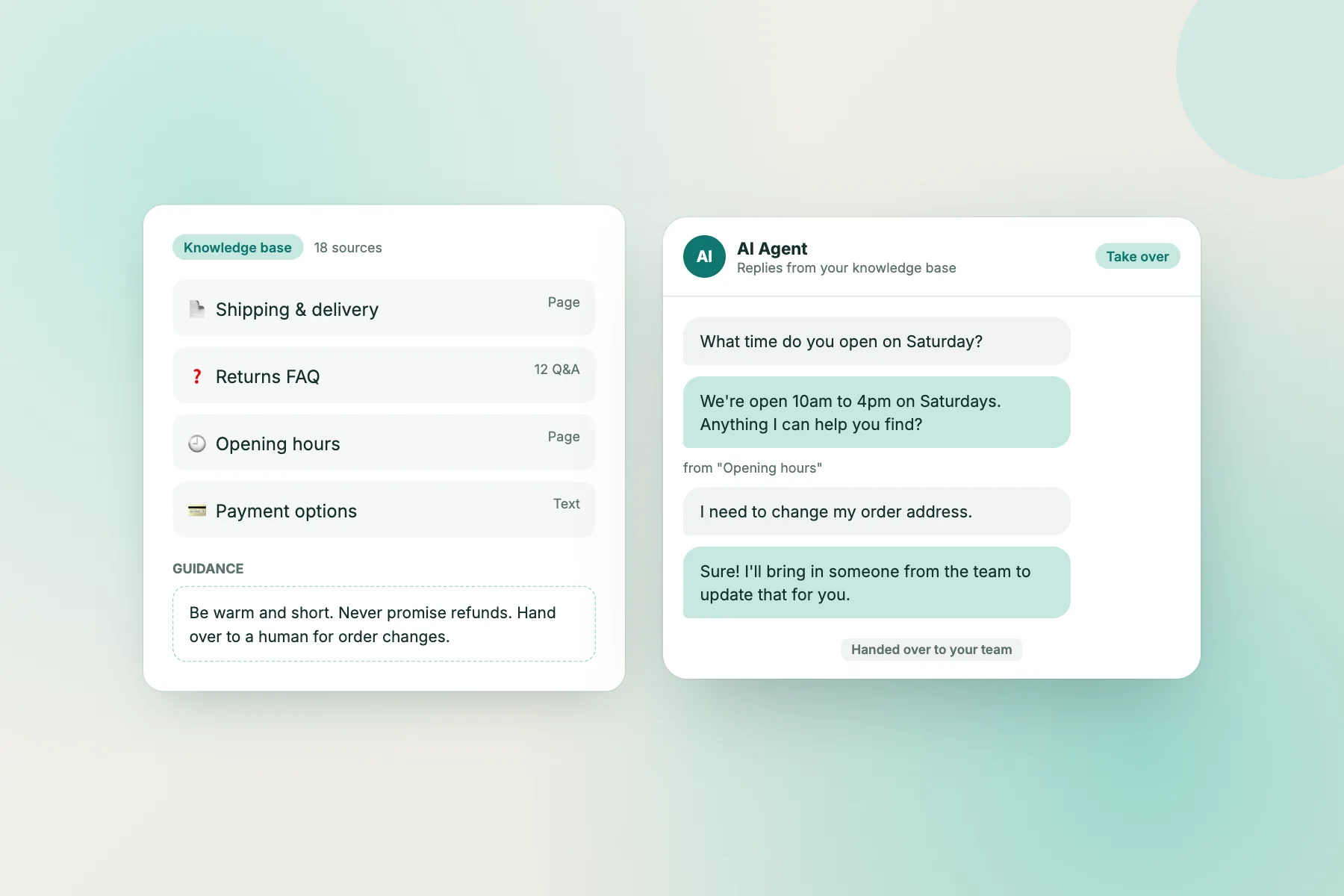
Good chatbots are built to fail safely. In LiveChatBot, the AI Agent answers from the knowledge you give it, and when it can’t, or when AI replies are used up, the free keyword bot answers from your saved replies. When neither has an answer, the chat goes to your team’s inbox, and outside opening hours the away form collects an email or phone number so nobody is left waiting in silence.
Make handover easy to find
Some bots hide the human option behind three menus because the owner wants to “reduce load”. That backfires. Customers who want a person and can’t find one leave, or come back angrier. Offer a person as a visible option after the first reply, and always when the visitor asks.
Be honest about the bot
Pretending the bot is a person named “Priya” damages trust the moment the visitor notices. A name is fine; a fake human identity isn’t. Say it’s an assistant, and say how to reach the team. Our page on telling visitors honestly has wording you can copy.
Group C · Fit with your business
Traits 7–9: is it your bot, or a generic one?
A bot can be accurate and honest and still feel wrong for your brand or your customers.
1
Knows your current facts
Test: ask about prices, timings and delivery charges, then compare with your website and what your staff would say today.
3 points: every fact matches, including this month’s changes.
2
Sounds like you
Test: read five replies aloud. Would your best staff member say it that way?
3 points: same tone, same words for your products, no stiff corporate phrases.
3
Works on a phone
Test: open the chat on a basic Android phone over mobile data.
3 points: loads quickly, doesn’t cover your buy button, text is readable, keyboard doesn’t hide the reply.
Group C in practice
Small fixes that move the score fastest
Fit is the group owners skip because the bot “works”. But fit is what makes a visitor feel they are talking to your business rather than a generic assistant.
Stale facts
The most common reason a once-excellent bot drops points is a change nobody told it about: a new price list, Diwali delivery cut-offs, a closed branch. Put “update the bot” on the same checklist as “update the website”. A monthly review takes ten minutes. The maintenance calendar we published lists what to check and when.
Voice
If your shop talks to customers in a warm, casual way, a bot that says “Kindly be informed that your query has been duly noted” feels foreign. Rewrite the five most common answers in your own voice and the rest of the bot will follow the pattern if it is AI-based. For keyword bots, every saved reply is written by you anyway, so this is a writing job, not a technical one. Saved replies can include {name} so answers feel personal.
Phones
In India, most visitors to small-business sites arrive on phones. Check the launcher position on your product and checkout pages; if it covers the Add to Cart button, move it or hide it there with the “where it shows” settings. Our guide on customising the widget covers position, colour and the attention grabber card.
Score it now
Your 27-point checklist
Tick each trait you’d give at least 2 points. Anything unticked goes on this month’s fix list.
Reading your total
What your score out of 27 means
Once you’ve scored all nine traits, add them up. The bands below are a rough guide, not a law; the trait with the lowest score always matters more than the total.
0–9: not ready for customers
The bot is likely creating more work than it saves. Consider switching it to a simpler mode while you fix the basics: a short welcome, three helpful buttons and a clear “talk to a person” option is better than a bot that guesses. Start with Group B, because honesty and handover protect you while you improve the rest.
10–18: useful, with gaps
This is where most small-business bots sit after their first month. Pick the two lowest traits and fix only those this month. Typical fixes: rewriting ten answers to be shorter, adding short forms to saved replies, making the person option visible.
19–24: solid
Your bot handles most visitors well. Improvements now come from reading real chats: which questions still go to a person that the bot could answer? Which answers get a follow-up question because they were incomplete?
25–27: excellent
Keep it there. Re-score monthly with new test questions, because a bot that scores 27 on the questions you trained it on may still struggle with the ones customers ask next season. Rotating fresh test questions is the only way to know the score is real.
Whatever the total, write down the date and the score. The improvement over three months is more motivating, and more useful, than any single number.
Common traps
Four ways owners fool themselves when scoring
Grading your own work is hard. These traps make a bot look better than it is.
- Testing with your own words. You know the product names and spell them correctly. Customers don’t. Borrow phrases from real chats, or ask a friend to test without briefing them.
- Testing only on a laptop. Most of your visitors are on phones. Always score trait 9 on a phone, ideally an older one on mobile data.
- Scoring the best reply. If a trait works three times out of five, it’s a 1, not a 3. Customers don’t get to retry until the bot behaves.
- Ignoring after-hours. Run at least two tests outside opening hours. Does the away form appear? Does the bot promise a reply time you can keep?
A second scorer helps. If two people score independently and compare, the disagreements show you exactly where the bot is inconsistent.
Getting started
Grade, fix one thing, grade again
Set a twenty-minute slot this week. Score the nine traits, pick the lowest one, and fix it. Next month, score again with new questions. That loop of scoring, fixing and rescoring is how good chatbots are made; none of them start out that way.
If you don’t have a bot yet, use the rubric as a specification. LiveChatBot’s free plan includes the chat widget, the AI Agent with a small monthly allowance of AI replies, the keyword bot with saved replies, opening hours with an away form, and the Android app for your team, on up to two websites with 100 free visitors per website each month. Create an account on livechatbot.in, teach it your top twenty questions, and score it before you tell customers it’s there.
Frequently asked questions
What makes good chatbots different from bad ones?
Mostly honesty and handover: they answer what was asked, admit when they don’t know, and pass visitors to a person quickly. Clever language matters less than correct facts.
Do I need an AI bot to score well?
No. A keyword bot with well-written saved replies can score well on honesty, handover, facts, voice and phone use. AI mainly helps with messy questions and context.
How often should I re-score?
Monthly is enough for most small businesses, plus after any big change such as new prices, a sale or new opening hours.
Who should do the scoring?
Ideally two people: the owner of the bot and someone who hasn’t been involved, so the test questions aren’t too polished.
Which trait should I fix first?
The lowest-scoring one. If several tie, fix Group B first, because a bot that guesses or blocks handover does the most damage.
Score your bot this week
Nine traits, twenty minutes, one fix. Start free on livechatbot.in if you don’t have a bot yet.