AI Chatbot Ideas for Student and Portfolio Projects: 24 Ideas by Skill Level, Each With a Twist That Stands Out
AI chatbot ideas for college and portfolio projects tend to collapse into the same three: a general Q&A bot, a movie recommender and a “mental health companion”. Examiners and interviewers have seen hundreds of each. A project stands out when it solves a narrow, real problem for real people, uses data you can actually get, and proves it works with numbers. This guide gives you 24 ideas sorted by skill level, the twist that lifts each one above the usual version, where to get the data, and how to test it, with a picker that matches ideas to your level, time and interests.
⚡ In short
- A good chatbot project is narrow: one group of users, one problem, one source of data.
- The twist is what gets noticed: citations, a regional language, honest handover, offline use or an evaluation suite.
- Only use data you’re allowed to use. Never build on other people’s personal data.
- Prove it works with a test set and numbers, then demo the hard cases, not just the easy ones.
What makes an idea good
Four tests every project idea should pass
Before you fall in love with an idea, check it against four questions. Most weak projects fail at least one of them.
Is there a real person with this problem? “A chatbot for everything” has no user. “A bot that tells first-year hostel students the mess timings, fees and rules” does. If you can name the person, you can test with them.
Can you get the data legally? A bot is only as good as what it knows. College notices, official scheme pages, your own notes and a shop owner’s answers are all obtainable. Scraped personal profiles, medical records or private chats are not, and using them can break the law, including India’s Digital Personal Data Protection Act, 2023.
Can you measure it? “It works well” isn’t a result. “It answered 41 of 50 test questions correctly, and handed over the other 9” is. Pick an idea where right and wrong answers are clear.
Can you demo it in three minutes? Your viva or interview is short. A narrow bot with a crisp demo beats an ambitious one that half-works.
Most of the AI chatbot ideas below are deliberately small. That’s the point: small, finished and measured beats large and unfinished every time. For the step-by-step project process from brief to demo, see the AI chatbot project blueprint.
Free tool
Find the three ideas that fit you
Choose your level, time, interest and whether you can use a paid AI API.
Runs only in your browser. Ideas are ranked by fit with your level, time and interest; “keep it free” removes ideas that need a paid AI API.
All 24 ideas
The full list, by skill level
Each idea is common in its plain form. The twist is what makes it yours.
| Level | Idea | The twist |
|---|---|---|
| Beginner | Campus FAQ bot | Every answer shows the notice it came from and its date. |
| Beginner | Canteen and timings bot | Understands Hinglish like ‘canteen kab khulega’. |
| Beginner | Library book finder | Fuzzy matching so ‘harry poter’ still works. |
| Beginner | Fridge-to-recipe bot | Filters for veg, Jain and no-onion-garlic diets. |
| Beginner | Local shop FAQ bot | Hands over to the owner’s WhatsApp number when unsure. |
| Beginner | Exam timetable helper | Exports a calendar file students can add to their phone. |
| Intermediate | Government scheme explainer | Asks questions, then says ‘you may qualify, check here’ with the official link, never a verdict. |
| Intermediate | Crop calendar bot | Works in the regional language, with voice input. |
| Intermediate | Interview practice bot | Scores answers with the STAR method and explains each score. |
| Intermediate | Notes Q&A with sources | Shows the exact paragraph used, so classmates can check. |
| Intermediate | Plain-language notice rewriter | Keeps every date, amount and deadline unchanged, and highlights them. |
| Intermediate | Money basics quiz bot | Explains, never recommends: refuses ‘what should I buy’ questions politely. |
| Intermediate | Metro and bus route helper | Works offline once loaded. |
| Intermediate | Scam message checker | Points to cybercrime.gov.in and the 1930 helpline for real cases. |
| Intermediate | Study planner bot | Uses spaced repetition and adjusts after each session. |
| Intermediate | College fest helpdesk | Updates live from one shared sheet the organisers edit. |
| Advanced | Multilingual support bot with tests | An automatic test suite scores answers in each language. |
| Advanced | Handover-aware support bot | Measures and reports its handover rate and reasons. |
| Advanced | Unsupported-claim detector | Highlights each sentence not supported by a source. |
| Advanced | Regional-language voice bot | Designed for low-end phones and slow networks. |
| Advanced | Appointment booking agent | Always confirms before booking and can undo. |
| Advanced | Prompt A/B tester | Blind human rating: raters don’t know which version they see. |
| Advanced | Review summariser bot | Shows counts and quotes for each theme, not just a summary. |
| Advanced | Accessibility checker bot | Explains each issue in plain words with the fix. |
The twist
Five ways to make any idea stand out
Look at the twist column above and you’ll see five patterns. You can apply any of them to an idea of your own.
Show your sources
A bot that says where its answer came from (“from the hostel notice dated 3 July”) is more trustworthy and much easier to test. It also shows you understand the biggest problem with AI answers: invented facts. Retrieval over your own documents, as in the notes Q&A idea, is the classic way to do it.
Speak the user’s language
Most student projects are English-only. A bot that handles Hinglish, Tamil or Marathi, even for a narrow topic, immediately feels useful and shows you thought about real users. Our Indian-language test pack has ready test questions.
Know when to stop
A bot that says “I’m not sure, here’s who can help” when a question is outside its knowledge is better than one that always answers. Measure how often it hands over and why. See handover patterns for how real support bots do it.
Work offline or on slow networks
Route helpers, timetables and catalogue search can run without a server. That’s a genuine advantage in places with patchy mobile data, and it removes API costs.
Build the evaluation, not just the bot
An automatic test suite that scores answers after every change is something most professional teams wish they had. It turns your project into a piece of engineering rather than a demo. The golden questions method is a simple starting point.
Data
Where to get data you’re allowed to use
Data decides whether your idea is possible. Good sources for student projects:
- Official public pages: government scheme pages, state agriculture calendars, transport timetables, investor-education glossaries. Link to the source in every answer.
- Open data portals: India’s open government data platform (data.gov.in) publishes many datasets under an open licence. Check each dataset’s licence before use.
- Your institution’s documents: prospectus, notices and timetables, with permission from the office that publishes them.
- Your own content: your notes, a glossary you write, test questions you create.
- A real partner: a shop owner, a club or a department that gives you their FAQs and agrees to test the bot.
And sources to avoid: scraped social media profiles, anyone’s private messages, health or financial records about real people, and copyrighted books copied in full. If your idea depends on them, change the idea. Interviewers notice when you’ve thought about this, and it’s a good habit for working life.
Framing
Weak project titles vs strong ones
Illustrative titles: the same work, described as a narrow problem with a measurable result.
Scoping
Fit the idea to the time you have
A weekend
One user group, one data source, keyword matching or a simple retrieval step, and a test with ten real questions. Beginner ideas in the list fit here. Skip the login page, the database and the pretty interface. A command line or a single web page is enough.
Two to four weeks
Add one twist properly: citations, a second language, or a handover rule. Build a test set of 30 to 50 questions with expected answers and report the score. Show the failures honestly in your report, with what you’d do next.
A semester
Now you can add an evaluation suite that runs automatically, a second round of user testing, and comparisons between approaches (for example, keyword matching vs retrieval vs an AI model). The advanced ideas belong here. Plan a “feature freeze” two weeks before the deadline: from then on, only fix and test.
Most AI chatbot ideas in the list can shrink or grow between these sizes: the campus FAQ bot is a weekend job with keywords and a semester job with retrieval, two languages and a test suite. Whatever the time frame, write the scope down on day one: who it’s for, what it answers, what it refuses, and how you’ll measure it. When you’re tempted to add a feature, check it against that page.
Proving it works
Test, measure, then demo the hard cases
The strongest projects end with a results table, not just screenshots.
Make a test set early. Collect real questions from the people you’re building for, before you build. Write the expected answer for each. Keep 20% aside that you never look at while building, and test on those at the end.
Measure two kinds of mistakes. Wrong answers, and refusals or handovers that weren’t needed. A bot that refuses everything is “never wrong” and useless.
Show the failures. Pick three questions the bot got wrong and explain why. Examiners and interviewers trust a candidate who understands their system’s limits.
Demo the hard cases. Everyone demos “what are the library timings?”. Show a misspelled question, a question in Hinglish, and a question your bot should refuse, and let the audience see it behave well.
If you’re building in Python, our Python tutorial walks from a keyword bot to grounded AI answers with a safe fallback, a good base for many of these ideas. And if you need slides for the final presentation, plan the demo first and build the slides around it.
Real-world pilot
Turning a project into something people use
A few of these ideas, especially the local shop bot, campus FAQ bot and fest helpdesk, can become real tools that people use after your project ends. That makes a strong line on a CV: “used by 300 students during the fest”.
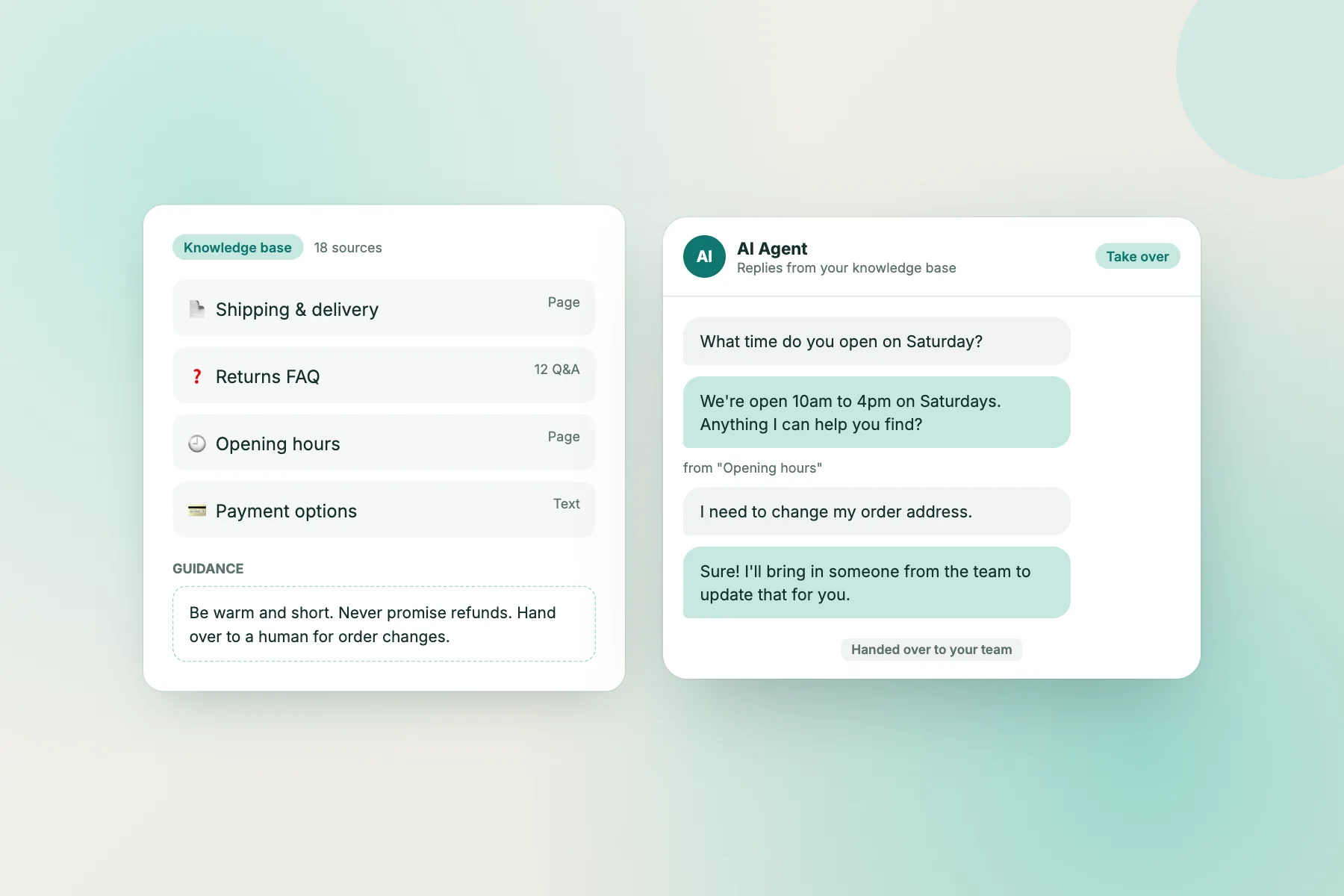
For a website version that a non-technical owner can maintain after you leave, a hosted chat tool is often more practical than your own code. With LiveChatBot, for example, a shop owner can add the chat to their site with one line of code, keep the AI Agent’s knowledge up to date themselves, and reply from the Android app when the bot hands over. The free plan covers two websites with 100 visitors per website each month, which suits a small pilot. Your project then becomes the research, the knowledge writing and the testing, which is the hard and interesting part anyway. See chatbot application ideas by department for the kinds of jobs real businesses hand to bots, or start on livechatbot.in.
Whichever of these AI chatbot ideas you choose, finish it, measure it and show its limits honestly. That’s what people remember.
Frequently asked questions
What are good AI chatbot ideas for a final-year project?
Narrow, real problems with data you can get legally: a notice-grounded campus FAQ bot, a scheme explainer that cites official pages, a scam message checker, or a multilingual support bot with an automatic test suite.
Do I need a paid AI API for a chatbot project?
No. Many good projects use keyword matching, retrieval over your own documents or open-source tools. Use the ‘keep it free’ option in the picker above.
Should I build a mental health chatbot?
It’s risky for a student project: the stakes are high and testing safely is hard. If health interests you, choose a narrower, lower-risk idea like a plain-language rewriter for public health notices.
How do I show my chatbot works?
Build a test set of real questions with expected answers, keep some aside until the end, report the score, and explain the failures.
How big should the project be?
Smaller than you think. A narrow bot that is finished and measured beats an ambitious one that half-works.
Keep reading
Related guides
AI Chatbot for Website Free: Will the Free Plan Cover Your Traffic? Count Your Visitors, Then Plan for Busy Months
AI Chatbot for Fun: 8 Games to Play With Any Assistant, Ready-Made Prompts, and Family-Safe Rules
AI Chatbot Features Ranked for Your Situation: What Each One Does in a Real Chat and Which to Switch On First
More to read
More guides on this topic
AI Chatbot for Student Enquiries: A Triage System That Sorts Questions by Urgency, Owner and Reply (Free Copy-Paste Replies)
Pick a narrow idea, then prove it works
Use the picker, write your scope on one page, and test with real users. Start a real pilot free on livechatbot.in.