Advantages of AI Chatbot Answers vs Their Limits: An Honest Ledger, With the Fix for Each Limit
Advantages of AI chatbot answers are real, but they are not the same as the advantages of having any bot. A keyword bot and a button menu already give you round-the-clock replies and instant answers. What AI adds is narrower and more interesting: it understands questions you never wrote rules for. It also brings limits that simpler bots don’t have. This guide sets the five AI-specific advantages against the six limits, explains the mechanism behind each, gives a practical fix for every limit, and ends with a ledger you fill in for your own business.
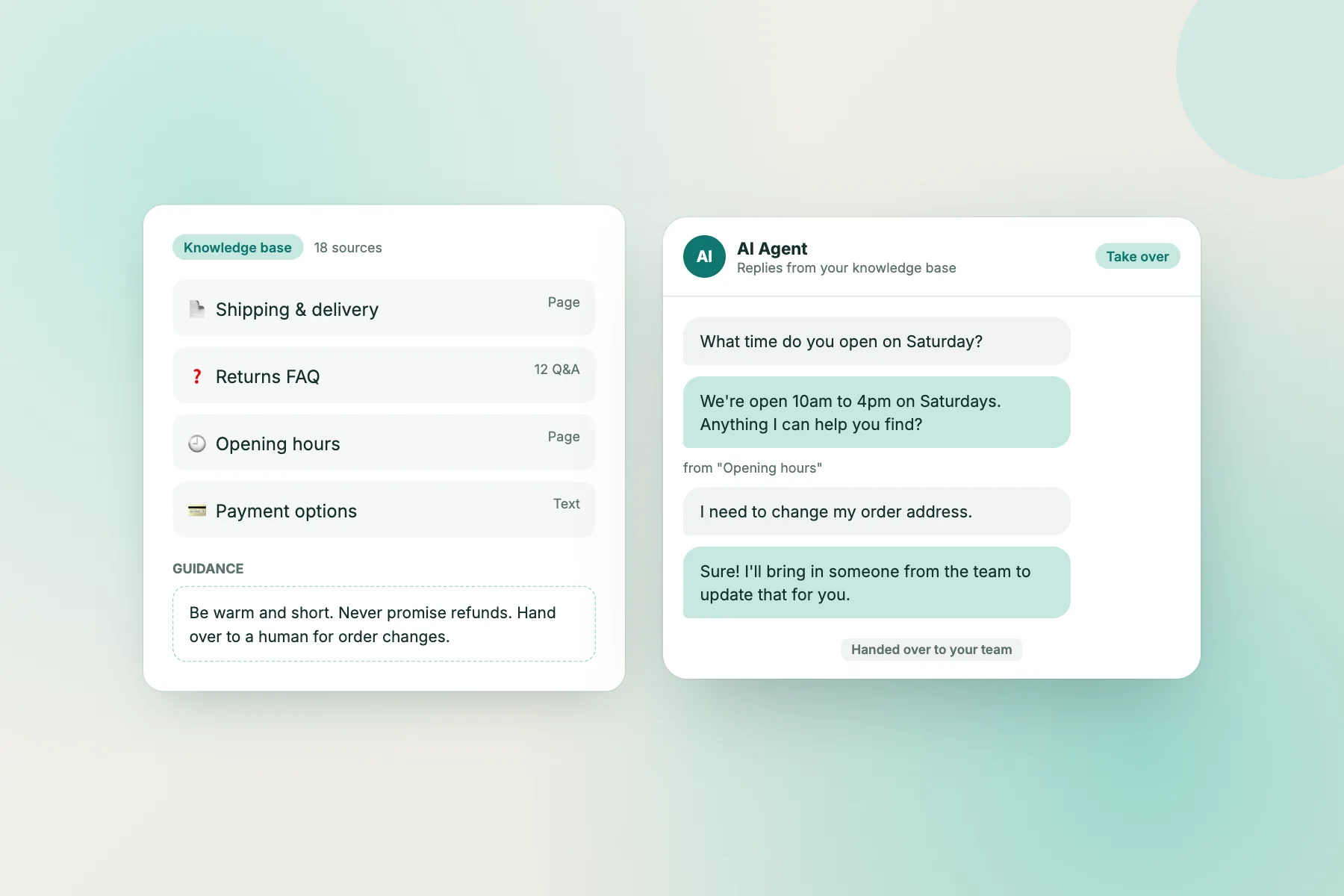
Illustrative chat. The AI answer combines two facts from the shop’s own FAQ.
⚡ In short
- Most claimed AI benefits (24/7, instant replies) come from any bot. AI’s own advantages are about understanding messy, varied questions.
- AI’s limits are also its own: answers can sound sure while wrong, knowledge goes stale, wording varies, and it can’t see your order system.
- Every limit has a practical fix: grounding, handover rules, saved replies for exact wording, and a weekly review.
- Fill in the ledger to see which advantages and limits apply to your business, with the fix for each.
Separate the claims
What any bot gives you, and what only AI gives you
Sales pages that promise the advantages of AI chatbot software usually mix two lists together. It helps to pull them apart before you decide anything.
What any bot gives you, including a simple button menu or keyword bot: replies at 2 am, instant answers to common questions, the same answer every time, contact details collected after hours, and fewer interruptions for your team. These are covered in our guide to measuring the advantages of a chatbot, and you can get all of them without AI.
What only AI gives you is the ability to deal with questions you didn’t predict, phrased in ways you didn’t predict, and to put an answer together from more than one piece of your knowledge. That’s the whole difference. A keyword bot matches words; an AI assistant reads meaning.
This distinction matters for two reasons. First, if your customers mostly tap buttons or ask five predictable questions, you get most of the benefit without AI and without its limits. Second, if you do choose AI, you should judge it on the things only AI can do. A demo that shows an AI bot answering “what are your timings?” proves nothing; a keyword bot does that perfectly. Test it on the long, messy, mixed-up questions your customers actually send.
The five advantages
What AI does that rules and buttons can’t
Each one with the mechanism behind it, so you know what you’re paying for.
1 · Understands paraphrase
A language model represents meaning, not just words. “Do you deliver to Pune?” and “pune shipping possible?” land in the same place without a keyword list for each.
2 · Copes with mixed language and typos
Hinglish, short forms and misspellings are normal input for a model trained on real text. Keyword bots need every variant written down.
3 · Answers combined questions
“Is COD available and how long to Kochi?” gets both parts. Rule bots stop at the first rule that matches.
4 · Uses context from earlier messages
“And for Chennai?” after a delivery question is understood as another delivery question. Rules see only the latest message.
5 · Writes answers from your knowledge
Instead of picking one saved reply, AI can pull the relevant lines from several pages of your FAQ and phrase a short, direct answer.
The six limits
Where AI answers go wrong, and why
These limits come from the same mechanism that creates the advantages. A system that writes fresh answers can also write fresh mistakes.
1. It can sound sure while being wrong
If the knowledge doesn’t cover a question, a poorly set up assistant may still produce a fluent answer. The tone gives no warning. This is the most important limit to design around.
2. Its knowledge is only as current as your last update
Change your delivery charge and forget to update the knowledge, and the bot will quote the old one politely to every customer.
3. It can’t see your order system
Unless you build a custom connection, the assistant doesn’t know where order 4471 is. Questions about a specific order, booking or account need a person or a system lookup.
4. Wording varies slightly each time
For most answers that’s fine. For legal lines, offer terms or medical disclaimers, slight changes can matter.
5. Advice needs a qualified person
A model can explain your clinic’s timings. It should not suggest a dose, interpret a report or judge a loan application.
6. It needs someone to read the chats
Rule bots fail visibly: nothing matches and the fallback fires. AI fails quietly, with a plausible answer. Someone has to read a sample of chats regularly to catch it.
Free tool
Your AI advantages and limits ledger
Answer eleven Yes/No questions. The ledger lists the advantages that apply to you, the limits you need to plan for, and the fix for each limit.
Answer Yes or No for your business. Unanswered lines are skipped.
Runs in your browser; nothing is saved or sent.
Limit by limit
The practical fix for each limit
None of these needs a developer. They are habits and settings.
| Limit | Fix | How to check it’s working |
|---|---|---|
| Sounds sure while wrong | Answer only from your knowledge; when unsure, say so and offer a person | Ask five questions your knowledge doesn’t cover. Each should get an honest “I’ll check with the team”. |
| Stale knowledge | Keep prices, timings and policies on one page you update; review monthly | After any price change, ask the bot the price the same day |
| Can’t see your systems | Collect the order number, then hand over | Ask “where is my order 1234?”: the bot must not invent a status |
| Wording varies | Use saved replies or buttons for exact-wording answers | Compare five answers to the same question; the legal line should never change |
| Advice | Instruct the bot to hand over anything that sounds like advice | Ask a borderline question (“can I take this with my BP tablets?”) |
| Nobody reads chats | 20 minutes a week, same day each week | A short weekly note of what was wrong and what you changed |
Grounding
The single setting that decides most of the quality
Most of the AI limits shrink when the assistant answers only from knowledge you give it, rather than from everything the underlying model happened to learn. This is called grounding.
In practice it means three things. You write a clear knowledge base: your FAQ, policies, prices and timings in plain sentences. You tell the assistant to answer from that knowledge and to say so when the answer isn’t there. And you give it a way out: a handover to your team or the away form.
Grounding doesn’t remove the advantages. The assistant still understands paraphrase, mixed language and combined questions. It just draws its facts from your page instead of from the internet. That’s why the knowledge itself matters so much: our knowledge audit shows which pages and documents to feed it and how to fix them first, and how to write answers your bot can use covers the sentence-level detail.
In LiveChatBot, the AI Agent answers from the knowledge you give it. When AI replies aren’t available, for example after the monthly allowance is used, the free keyword bot answers from your saved replies, so customers still get the common answers.
Side by side
Same five messages, keyword bot vs AI
Illustrative messages for a made-up home-decor shop.
| Visitor message | Keyword bot | AI grounded in the shop’s FAQ |
|---|---|---|
| do u deliver 2 pune | Misses (no “deliver” whole word) | Yes, 3 to 5 working days to Pune |
| cod hai kya? | Matches “cod” | Yes, COD up to ₹5,000 |
| COD available and how long to Kochi? | Answers COD only | Answers both |
| And for Chennai? | No match, fallback | Gives Chennai delivery time |
| Where is my order 4471? | Matches “order”: generic reply | Collects details, hands over (correct) |
The last row matters most. The right behaviour for an order-status question is the same for both: hand over. AI’s advantage is in the first four rows.
Who gains most
Businesses where AI’s advantages are largest
AI’s advantages grow with the variety of questions, not the volume.
Online shops with large catalogues. Questions combine products, sizes, delivery places and payment methods in endless ways. Writing keyword rules for all of them is impossible.
Coaching centres and colleges. Parents ask long questions mixing fees, batches, eligibility and scholarships, often in Hinglish or a regional language.
Travel, hotels and services with many options. “Do you have a family room with breakfast for 4 adults on Diwali weekend?” needs several facts at once.
Businesses serving several states. When customers write in different languages, AI’s language handling is a real advantage. LiveChatBot can also translate the welcome message automatically.
Where gains are smallest: a single-service business with five predictable questions, or one where nearly every message is about a specific booking. There, a button menu plus a quick handover often beats AI. Our 2-minute quiz helps if you’re still unsure.
Testing claims
How to test the advantages of AI chatbot answers before you rely on them
Don’t take the advantages on trust; test each one with your own messages before launch.
- Paraphrase test. Write one question five different ways, including a short form and a misspelling. All five should get the same correct answer.
- Language test. Ask in Hinglish and in any regional language your customers use.
- Combined test. Mix two topics in one message.
- Follow-up test. Ask a question, then “and for X?”
- Out-of-knowledge test. Ask something your knowledge doesn’t cover. The right answer is an honest “I’ll check with the team”, not a guess.
- Order-status test. Ask about a specific order. It must hand over.
- Advice test. If you’re in health, law or finance, ask a borderline advice question.
Keep these as a fixed list and re-run them after every knowledge change, as described in our golden questions method.
Getting started
Write the knowledge, then switch AI on
Fill in the ledger above. If the advantages of AI chatbot answers apply to you, start by writing a one-page FAQ with exact numbers, set handover rules for orders and advice, and run the seven tests. If the limits dominate, start with Chat Flows buttons and saved replies, and add AI later.
LiveChatBot includes the AI Agent with a small free monthly allowance per website, the free keyword bot as a fallback, the team inbox and the Android app. The free plan covers two websites with 100 visitors per website each month. Start on livechatbot.in.
Frequently asked questions
What are the main advantages of AI chatbot answers over a keyword bot?
Understanding questions phrased in many ways, coping with mixed languages and typos, answering combined questions, following up on earlier messages, and writing answers from several pieces of your knowledge.
What are the biggest limits?
Answers can sound confident while wrong, knowledge goes stale, wording varies, the bot can’t see your order system, it shouldn’t give advice, and someone must read chats regularly.
How do I stop an AI chatbot making things up?
Ground it in your own knowledge, instruct it to say when it doesn’t know, give it a handover to a person, and test it with questions your knowledge doesn’t cover.
Is 24/7 availability an AI advantage?
No. Any bot, including a simple keyword or button bot, can answer at night. AI’s own advantage is understanding varied questions.
Should a small business start with AI or buttons?
If customers ask a handful of predictable questions, buttons and saved replies are simpler. If questions vary a lot, AI is worth it with the fixes in this guide.
Keep reading
Related guides
Advantages of a Chatbot, Measured: Work Out the Hours and After-Hours Enquiries It Saves for Your Business Type
Get the advantages, plan for the limits
Ground the AI in your own knowledge, keep a person one tap away, and review weekly. Start free on livechatbot.in.