AI Chatbot Examples, Side by Side: 10 Weak Answers Rewritten Into Strong Ones
AI chatbot examples are most instructive in pairs: the same question answered badly and then well. Seeing the difference side by side trains your eye faster than any list of rules. Here are ten common customer questions, each with a weak answer you’ve probably seen on real websites and a rewritten strong one, plus a sentence on why the rewrite works.
Fact first, specific, one next step.
⚡ In short
- Strong answers put the key fact first, use your real numbers, and end with a next step.
- Weak answers hedge, ramble, ignore half the question, or leave visitors stranded.
- Most weak answers come from missing knowledge or missing format instructions, not weak AI.
- Use the scoring checklist at the end to grade your own bot’s answers.
How to read the pairs
What makes an answer strong
Each pair below shows the same visitor question twice. On the left, a weak answer of the kind that turns up on many real websites: technically polite, often not wrong, but unhelpful. On the right, a strong answer written to the same facts. The point isn’t that the weak bots lacked intelligence; it’s that they lacked the right knowledge, instructions or boundaries.
As you read, look for five qualities in the strong answers:
- Key fact first. The price, time, yes or no appears in the first sentence.
- Specific. Real numbers and conditions, not “may vary”.
- Complete. Every part of a multi-part question answered.
- Honest about limits. No guessing; a handover when needed.
- A next step. A link, a question or an offer that moves things forward.
These ten AI chatbot examples cover the situations small business bots face most: delivery, prices, availability, returns, two-part questions, complaints, out-of-scope questions, medical questions, unknowns and requests for a person.
The ten pairs
Weak versus strong, question by question
Click a number to see each pair.
Why the strong one wins: It answers the actual city with real numbers instead of sending the visitor away to read a policy page.
Why the strong one wins: Marketing language doesn’t answer a price question. The strong answer names the product, price and what’s included.
Why the strong one wins: If the bot has stock knowledge, it should use it; if not, it should say so and offer a person, not deflect.
Why the strong one wins: The visitor wants yes or no plus how. ‘Subject to terms’ answers neither.
Why the strong one wins: Two-part questions need two answers. The weak reply ignored Chennai.
Why the strong one wins: It acknowledges the specific frustration, collects what’s needed and hands over instead of asking for patience.
Why the strong one wins: A business bot answering general trivia drifts out of scope. Politely redirecting keeps it focused and avoids odd answers.
Why the strong one wins: Health questions need professionals. The weak answer makes a safety claim the business can’t stand behind.
Why the strong one wins: If the knowledge doesn’t cover it, the bot must not invent a policy. An honest ‘let me check’ protects everyone.
Why the strong one wins: Ignoring a request for a person is the fastest way to lose trust. Hand over, and collect context to save time.
Patterns
What the weak answers have in common
Look across the ten weak AI chatbot examples and three patterns explain almost all of them.
Pattern 1: deflection
“Please check our policy page”, “Please check the product page”, “Subject to terms and conditions.” The bot points elsewhere instead of answering. Usually it’s because the relevant facts weren’t in its knowledge, or the instructions didn’t tell it to answer directly.
Fix: add the specific facts, and instruct the bot to answer with them in the first sentence.
Pattern 2: generic politeness
“We apologise for any inconvenience”, “We offer competitive prices.” These phrases fill space without saying anything. They often come from old templates or from a bot told to “be professional” without more detail.
Fix: ban filler phrases in your tone instructions and give examples of plain, specific answers.
Pattern 3: overconfidence
“Yes, we ship worldwide!”, “Safe for everyone!”, answering trivia. The bot is being helpful in the wrong direction, inventing or overstepping.
Fix: clear scope and limits: answer only from knowledge, say when unsure, hand over sensitive topics. Our guide to writing bot instructions covers all three fixes.
Grade your bot
Score your own answers
Ask your bot your ten most common questions. Tick each quality the answers show.
Fixing answers
A quick routine for turning weak into strong
When you find a weak answer in your own chat history, use this routine. It takes a few minutes per answer.
- Copy the question and the weak answer into a note.
- Write the strong answer yourself, as your best team member would say it.
- Compare. What’s in your answer that the bot didn’t have? Usually a specific fact, a condition, or a boundary.
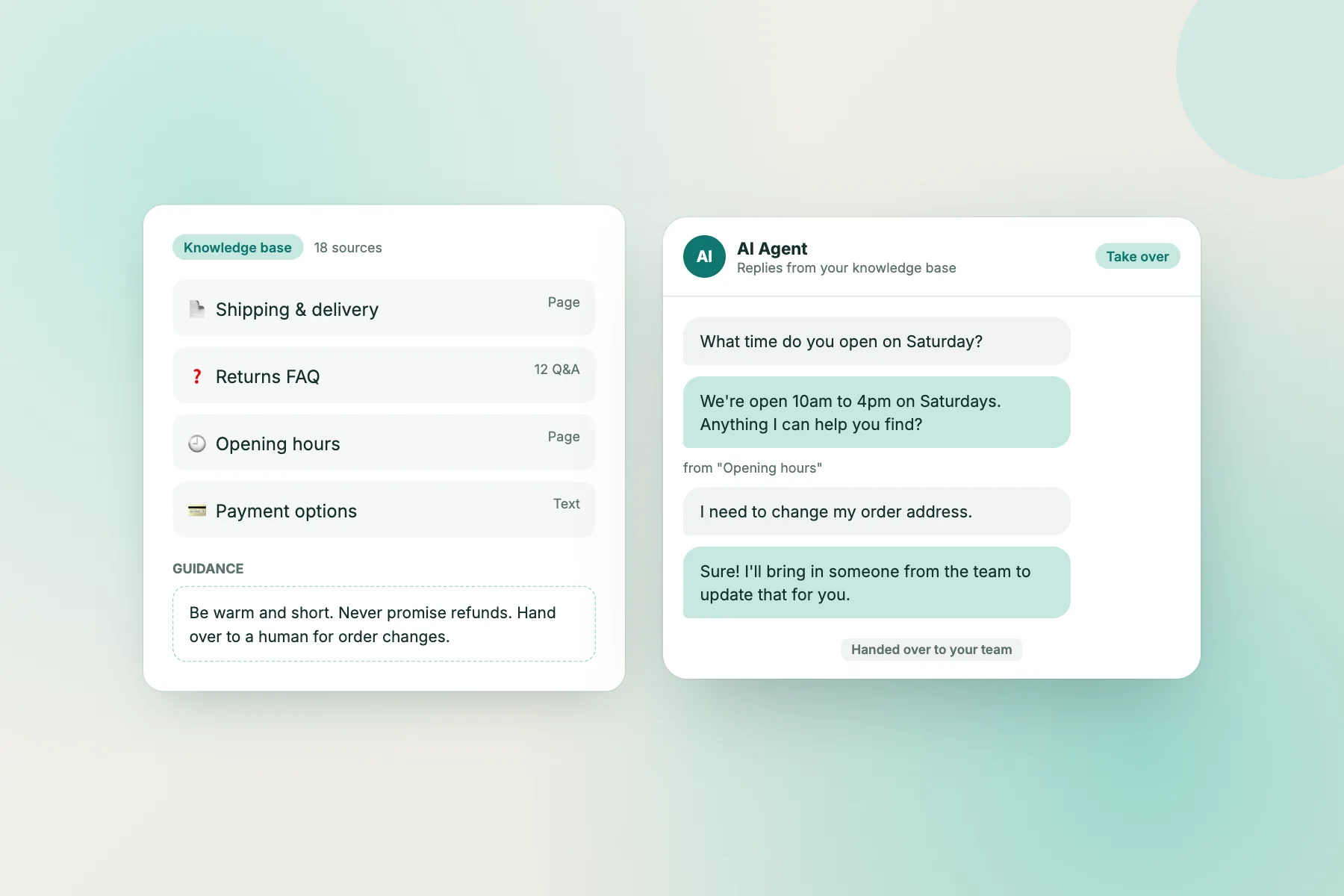
- Fix the source. Add the missing fact to the bot’s knowledge, or the missing behaviour to its instructions. If you use saved replies, update the reply.
- Ask again. Test the same question, plus two variations with different wording and typos.
- Save the pair. Keep a running document of before-and-after pairs. It becomes a training record for new team members too.
Doing this for five answers a week compounds fast. After a month, most of the common questions will have strong answers. The guide on training your AI chatbot explains where knowledge and instructions live in LiveChatBot.
Beyond single answers
Strong conversations, not just strong replies
These AI chatbot examples focus on single answers, but customers experience whole conversations. A few habits make the conversation as strong as each reply.
Remember the context
If the visitor asked about the Oslo sofa, “does it come in green?” refers to the Oslo sofa. Good bots keep track; test yours with follow-up questions.
Don’t repeat the welcome
After the first message, the bot shouldn’t reintroduce itself or repeat its opening line.
Close the loop
When a visitor says “thanks”, a short “You’re welcome! Anything else?” is enough. Don’t restart a sales pitch.
Hand over smoothly
The person who takes over should see everything the bot learned, so the visitor never repeats themselves. For more on whole-conversation design, see the chatbot user experience journey map.
Try it yourself
Run the ten questions on your own site
The fastest way to improve is to see your own bot’s answers next to these. Open your site on a phone in a private window and ask the ten questions above, adapted to your business. Screenshot each answer. Compare with the strong versions, grade with the checklist, and fix the weakest three this week.
If you don’t have a bot yet, LiveChatBot’s free plan includes the AI Agent, which answers from the knowledge you give it, and a free keyword bot that uses your saved replies, plus Flows, tickets and an Android app, for two websites with 100 visitors per website each month. AI replies have a small free monthly allowance. Start on livechatbot.in, write strong answers for your top ten questions, and run the test. For more conversation-level examples, see our best AI chats collection.
Frequently asked questions
Are these AI chatbot examples from real businesses?
They’re realistic illustrations based on common questions and common mistakes. The products, prices and names are examples.
Why do bots give weak answers?
Usually because of missing knowledge, vague instructions, or no limits on scope. The AI itself is rarely the main problem.
How long should a bot’s answer be?
Two or three short sentences, with the key fact first. Longer answers should be split or linked.
Should a bot answer general questions?
A business bot should politely stay in scope. Answering trivia or unrelated questions can lead to odd or wrong replies.
How do I improve my bot’s answers?
Collect weak answers, write strong versions yourself, then fix the missing knowledge or instruction behind each, and re-test.
Keep reading
Related guides
AI Chatbot Design: How to Write the Instructions That Shape Every Answer Your Bot Gives
AI Chatbot Builder Walkthrough: Build a Booking Assistant Without Code, Block by Block
AI Chat Software Due Diligence: A Security and Privacy Checklist Before You Sign Up
Turn your weakest answers into strong ones
Run the ten questions, fix three answers this week. Free on livechatbot.in.