AI Chatbot With Knowledge Base: A Plain-English Glossary of the Words Vendors Use, and the Question to Ask About Each (Free Jargon Search)
AI chatbot with knowledge base is the phrase on almost every product page, yet the pages around it fill up with terms like RAG, embeddings, grounding and sources. This guide translates them into plain English, pairs each with one question to ask the vendor, and explains how LiveChatBot’s AI Agent treats the knowledge you give it.
⚡ In short
- A knowledge base is the set of facts the bot is allowed to answer from. Quality of the facts matters more than the tool’s label for them.
- Learn the twelve terms in the glossary below, so a feature list stops sounding like a foreign language.
- LiveChatBot’s AI Agent answers from knowledge you give it. It does not train on uploaded PDF or other files.
- When the knowledge has no answer, a good bot should say so and hand over to a person.
The basic idea
What an AI chatbot with knowledge base is, in three sentences
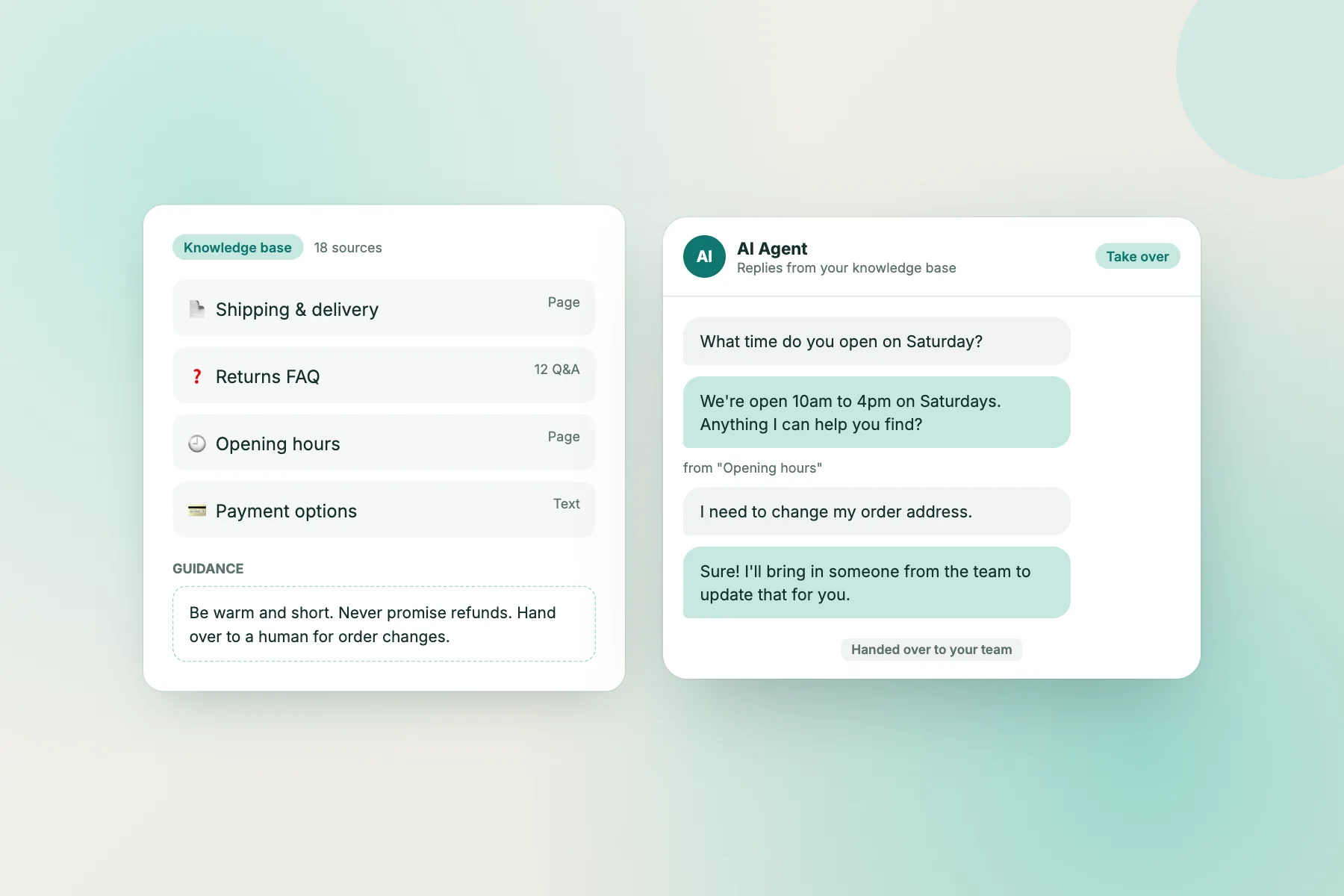
A knowledge base is your business facts written down where the bot can read them: prices, opening hours, delivery areas, returns, how to book, what you do not do. When a visitor asks something, the bot looks for the most relevant facts and writes a reply from them.
That is the whole idea. Everything else on a vendor’s page is detail about how the facts get in, how the bot finds the right ones, and what happens when it cannot.
The bot does not know your business from the internet or from its own training. If a fact is not in the knowledge base, a well-behaved bot should not invent it. For the PDF question in particular, our guide to turning PDFs into answers explains why raw files make poor knowledge. Our guide on writing answers your bot can use covers the writing side. This page covers the vocabulary around it.
Search the words
AI chatbot with knowledge base jargon, decoded
Type a term, such as grounding or chunk, to filter the list. Each entry ends with the question to put to a vendor.
Reading the answers
What good answers to those questions sound like
You do not need the technical details. You need to hear that the vendor has thought about the problem.
Good signs
- They tell you where the knowledge lives and let you edit it directly.
- They admit the bot can be wrong and describe how to find and fix mistakes.
- They explain the fallback in one sentence and show it in a demo.
Warning signs
- “The AI just knows.” Nothing just knows your return policy.
- A promise of 100% accuracy.
- Dense jargon in reply to a plain question. That can mean the answer is uncomfortable.
Ask for the answers in writing if you can. A reply in a chat window is easy to forget, and a written one gives you something to hold the vendor to if the product behaves differently after you sign up. Ask the same three questions of every vendor on your shortlist and write the answers in a table. Differences stand out fast. For a longer test with real questions, see how to train your AI chatbot.
What LiveChatBot does
How LiveChatBot works as an AI chatbot with knowledge base
LiveChatBot’s AI Agent answers from the knowledge you give it, and has a small free monthly allowance per website. After that you can buy AI packs. If the AI is unavailable or the allowance is used up, the free keyword bot answers from your saved replies, so visitors still get something useful. Your team can step into any chat from the inbox or the Android app.
What it does not do
It does not train on uploaded PDF or other files, so paste your facts as clear text instead. It does not promise perfect accuracy. It does not remove the “Powered by LiveChatBot” badge on any plan. There is no sentiment analysis or voice.
Where the keyword bot helps
Saved replies are the safety net. Write replies for your five most common questions, such as hours, price, delivery, returns and contact. Even if the AI is off, visitors still get a correct answer.
Why that can still be enough
Most small businesses have fewer than fifty facts that matter. Typed carefully, they cover the bulk of repeat questions. See the AI Agent page for current details and pricing for the free plan.
Keeping it healthy
Three habits that keep a knowledge base useful
A knowledge base decays quietly. Prices change, offers end, hours shift for a festival. Three habits keep it honest.
Review it monthly
Read ten recent chats the AI answered. Note every wrong or vague reply and fix the fact behind it.
Add one entry per missed question
Whenever a person had to take over a chat, ask whether a fact could have prevented it. If yes, write that fact the same day.
Keep one owner
Name one person who is responsible for the knowledge, even in a team of three. When everyone can edit it and nobody owns it, contradictions creep in: one entry says free delivery over ₹999, another says ₹1,499. Give the owner a calendar reminder on the first of each month.
Remove, do not just add
Old offers and discontinued products cause the worst errors. Delete them as soon as they end. A shorter, current knowledge base beats a long, stale one every time.
Frequently asked questions
What is an AI chatbot with knowledge base?
A bot that answers visitors from a set of facts you supply, rather than from general internet knowledge.
Can I upload PDFs to LiveChatBot?
No. The AI Agent does not train on uploaded files. Paste the facts as clear text.
What happens if the knowledge base has no answer?
A good setup hands over to a person or collects contact details. The free keyword bot also answers from saved replies when the AI is unavailable.
How big should a knowledge base be?
Start with your top twenty questions. Grow it from real chats rather than guesses.
Do I need to understand RAG or embeddings?
No. It helps to know the words so a vendor cannot hide behind them, but you only need to judge answers.
Keep reading
Related guides
Chatbot With Appointment Booking: Three Levels, From Request Collector to Calendar Sync, and How to Pick by Your Booking Volume (Free Setup Recommender)
Chatbot Trained on Website Content: Which Pages to Feed It First, Which to Leave Out, and When to Refresh (Free Page Priority Checklist)
Chatbot With Lead Capture That People Actually Answer: When to Ask, What to Ask For, and the Exact Words (Free Ask-Line Scorer)
Give your bot facts it can use
Start free on livechatbot.in, add your top twenty answers and watch the AI Agent use them.